
Site Education & Navigation Starts Here
Before you explore — we ask you to consider the difference between what you were TAUGHT, what you were NEVER TOLD & what you were TOLD to KNOW.
A guide for your research
How to Use This Education Page
This page is a starting point, not the whole classroom. The education throughout the Legacy Preservation Project is woven across the site: Heritage explains the record systems and classification language; Ethnogenesis explores how communities formed and renamed. The Malone, Burton, Tonkawa, and Freedom Colony pages, connect those ideas to family, places, and lived history. We teach through our own heritage and experiences. The journey is self- rewarding and beneficial to all.
Begin with the topic that speaks to your own family story, then follow the links, timelines, records, images, and LPP Notes. They will lead you deeper. Use the Sections menu to move between subjects and return here whenever you want a guide to the larger picture. Start with asking yourself the tough questions you often contemplate: Everyone in my family says we have indigenous blood. why? Why can't I find any of my family on slave schedules? How did we get our last name? Why does the family information or trail seem to just stop or grow cold? Why am I sometimes questioned about my unique way of doing things in regards to my culture and or heritage?
We teach through our own family heritage because family memory, documents, migration paths, and community history can make difficult historical systems easier to understand. These examples are offered as a way to learn how to ask better questions of your own records — not as a substitute for your family's distinct evidence and story.
Why We Teach the Way We Do
“We teach through our own family heritage — because the Burton and Malone lines are not just examples.”
They are the proof.
— Legacy Preservation Project
Family memory, documents, migration paths, and community history make difficult historical systems easier to understand. Every guide on this page is grounded in evidence we recovered from our own records — so you can learn how to ask better questions of yours.
Let our legacy pages be your light.
Institutional Education
The broad, formal system of teaching and learning core academic skills, sciences, and general knowledge.
Heritage Education
A targeted approach that uses cultural history, local artifacts, proven past events, traditions, and family examples as tools to teach identity, citizenship, and legacy preservation.
Anthropological Classification Education
The formal scientific framework used in census records, Dawes Rolls, and colonial-era legal documents to classify the three recognized racial stocks of humanity — Negroid, Caucasoid, and Mongoloid. Understanding this vocabulary is essential to reading your family's paper trail accurately.
View the Three Classifications →Milam County & Slavery in East-Central Texas
A documented history of the cotton economy, enslaved populations, and Free People of Color in Milam County — the land where the Burton and Malone families were rooted. Understanding this context is essential to reading their records accurately.
Read the Full History →Why We Call Them DNA Casinos
Commercial DNA ancestry tests make bold claims about ethnicity and heritage. The science behind those claims is far weaker than their marketing suggests. Before you hand over your genetic material, read what the peer-reviewed research actually says.
Read the Research →Feel free to visit the Sections page to find topics and navigate the website with no restrictions. Use the tabs as guides — they will introduce new topics as you scroll.
Because we are a nonprofit organization, we are limited in how many families we can accept into the program each year. This is why we freely share information on how to preserve your legacy and reclaim your heritage — DIY.
The education shared here is provided to help the seeker and researcher with alternative insights — minus social, political, religious propaganda and selective bias.
Most importantly, have fun exploring who you are. As we say — your heritage awaits you.
Throughout this site you will encounter boxes labeled LPP Note — and they are unlike anything you will find in a classroom.
These are candid, off-the-record observations from the researcher — personal notes, family memory, oral tradition, cultural humor, and the kind of unfiltered insight that formal education tends to leave on the cutting room floor. Think of them as the researcher leaning over and whispering what the textbook would never say.
You may find a joke. You may find a hard truth. You may find a piece of family lore passed down through generations that no archive ever recorded. That is exactly the point.
When you see the gold box — pay attention. That is where the real education lives.
Understanding Heritage Reclamation
A foundational guide to recovering ancestral identity erased by colonial classification systems — for triracial families, mixed-heritage legacy, reclassified and misclassified Free People of Color in territory of North America
What Is Heritage Reclamation?
Heritage reclamation is the scholarly and genealogical process of recovering an ancestral identity that was deliberately obscured, suppressed, or erased through colonial-era classification systems. It is not a matter of personal preference or cultural appropriation — it is the documented restoration of lineage, taken.
For centuries, Indigenous peoples, Free People of Color, and mixed-heritage families were systematically reclassified by census enumerators, church registrars, and government officials who imposed racial categories that did not reflect lived reality. The consequences of those decisions echo across generations — families who no longer know what nation they belong to, communities severed from treaty rights and cultural continuity, and individuals who carry the physical and spiritual inheritance of their ancestors without the documentation to prove it.
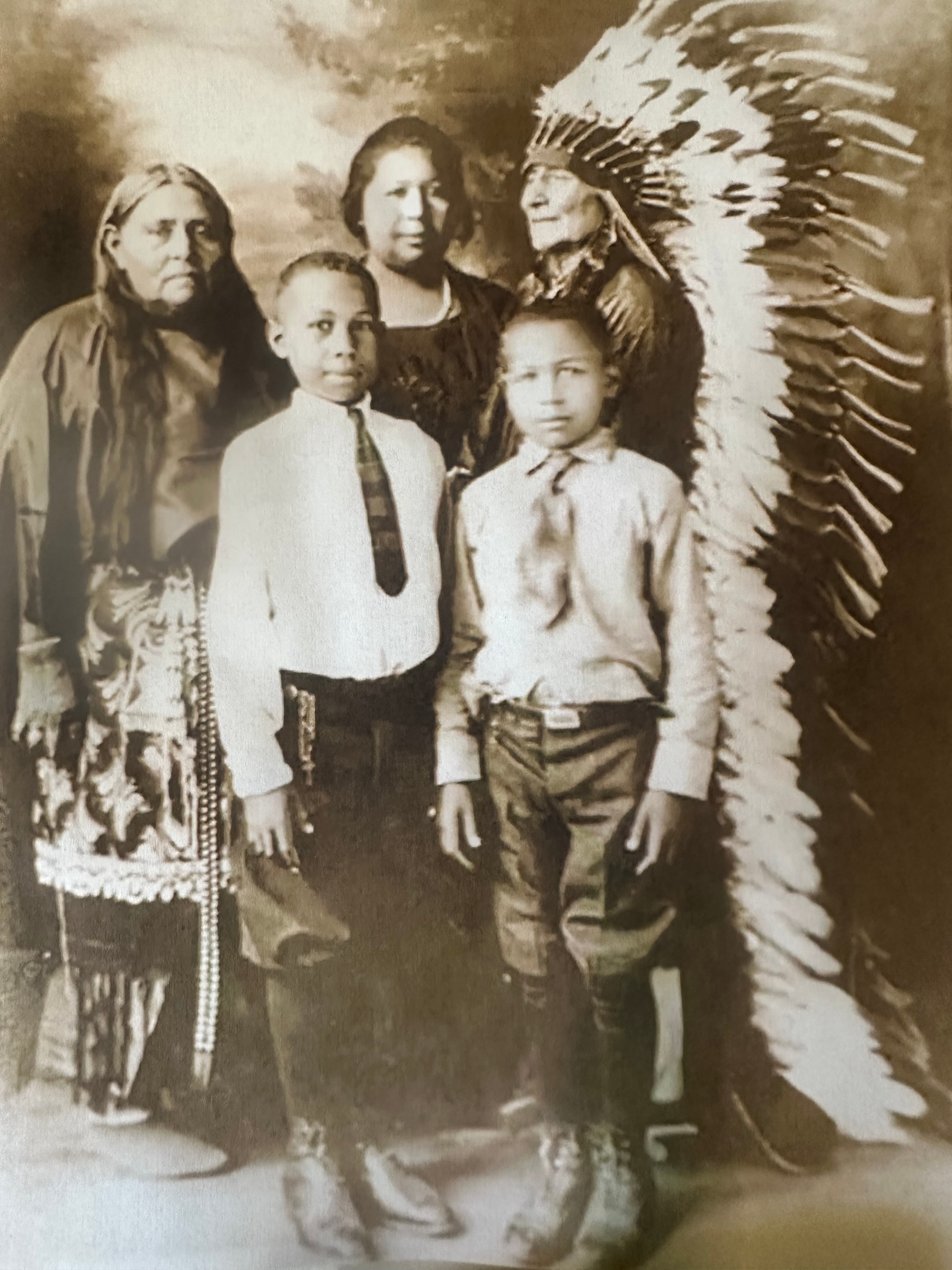
Milam County History · What Families like the Malones of East Central Were Never Told
Understanding Milam County's Real Origins
Before you can understand the silence, you need to understand the county.
Understanding Milam County's Real Origins
Milam County did not begin as "Milam County." In 1803, the land the Malone ancestors lived on was not part of the United States, not part of Texas, and not a county at all. It was part of Viesca, Mexico, under Spanish and later Mexican rule. This matters because the laws, racial categories, and population patterns were completely different from what people assume today.
When Texas later became a Republic and then a state, Milam County was enormous — one-sixth of the entire state. It stretched across a massive region that included what would later become Bell, Falls, Williamson, and Robertson counties.
This huge territory had a small population, and only about 100 enslaved people lived there before the cotton boom. Once cotton exploded, everything changed.
The Cotton Boom: How Milam's Slave Population Skyrocketed
Between 1850 and 1860, Milam County's enslaved population jumped dramatically:
1850: 436 enslaved people
1860: 1,542 enslaved people
This increase did not come from African BORN people directly. It came from the domestic slave trade — enslaved people moved from east to west, sold, or trafficked from other east coast states, to the western states and into Texas. Slavery Texas was a major hub of this domestic trade, especially after statehood in 1845.
The Truth: No Slave Ships Legally Brought Africans Directly to Texas
Many families who identify as African American descendants were taught that everyone came from Africa. LPproject.org stands firm in their research that ALL life originated out of Africa, but East Central Texas was different, and the historical record proves it. Melanated peoples existed in Meso America long before colonization. Not all indigenous people look like Indians on TV.
The international slave trade was outlawed in 1808. After that date, no enslaved Africans could legally be imported into the United States.
Texas was still under Mexico during this period. Mexico abolished slavery, and enslaved people fled toward Mexican territory seeking freedom.
Any Africans brought directly into Texas ports (like Galveston) were smuggled illegally. Historians documented illegal slave landings at Velasco and Matagorda Bay in the 1830s — these were smuggling operations, not legal importation.
This means: there SHOULD be records. Because enslaved people in Texas were overwhelmingly born in the U.S., sold through the domestic slave trade, moved from other states, and documented in bills of sale, probate records, and tax rolls. Family is right to expect documentation — because Texas slavery was domestic, not international.
East-Central Texas Was Home to Thousands of Free People of Color
This is the part family was never taught:
Texas had one of the largest populations of free people of color in the South.
Indigenous
African-Indigenous
Afro-Mexican
Mixed-race frontier families
Freedmen who migrated during Reconstruction
People who lived in freedom colonies like Cox's, Two Mile, and Little River
This is why some families like — Malone, Hodges, and Kerr, — do not fit the "everyone came from Africa" narrative.
Creek refugees
Tonkawa survivors
African-Creek families
Free people of color
Frontier mixed-heritage communities
Domestic-trade enslaved people born in the U.S., not Africa
This family history is Texas history, not the simplified version taught in school.
Why This Matters for Melanated Texans:
Because— Many families in East-Central Texas — inherited a story that was incomplete. Not wrong, but incomplete.
They were told:
"All Black people came from Africa."
"Texas slaves came from Africa."
"Everyone with melanin has the same origin."
But the truth is:
Texas was part of Mexico, not the U.S., during the era of African importation & people of color have always existed in North America.
Mexico abolished slavery and protected fugitives.
Texas slavery was overwhelmingly domestic, not African.
Illegal smuggling did occur — but it was rare, dangerous, and documented.
East-Central Texas had a huge population of free, mixed, Indigenous, and Afro-Native families.
Your consistent work with The Legacy Preservation Project is correcting the record — not rewriting it.
Understanding where the Malones come from begins with understanding where Texas came from in the Malone Family case. Milam County was born out of Mexico, shaped by the domestic slave trade, and built by Indigenous, African-Indigenous, and free people of color whose stories were never written into textbooks. We preserve these truths because they belong to us — and because our ancestors deserve to be remembered accurately.
The Smoking Gun
Why We Call Them DNA Casinos
The science is real. The marketing is not.
Commercial DNA ancestry tests make bold claims about ethnicity, heritage, and percentages. But the science behind those claims is far weaker than their marketing suggests. Before you hand over your genetic material — and your money — you deserve to know what these companies are actually selling.
The core problem is that these companies do not compare your DNA to ancient populations or verified historical groups. They compare you to their own private databases — which are incomplete, biased, and constantly changing. This means your results are not objective scientific facts. They are statistical guesses based on who else has tested with that company. When a company tells you that you are 20% Scottish or 12% Indigenous, they are not identifying actual ancestors. They are identifying clusters of modern customers who share similar DNA patterns, and then labeling those clusters with ethnic names for marketing appeal. This is why your results can change dramatically from year to year: the company updates its database, reassigns clusters, or changes its algorithm — and suddenly your heritage shifts.
Another major issue is that DNA companies cannot detect specific tribes, nations, or historical communities. The American Association of Biological Anthropologists has repeatedly stated that consumer DNA tests cannot identify tribal affiliation or Indigenous ancestry with certainty. The National Congress of American Indians has publicly warned that DNA tests cannot prove tribal identity or descent. The African American DNA Roots Project has shown that commercial tests routinely mislabel West African ancestry because their reference panels are too small and too modern. These companies know this — but they still sell ethnicity estimates as if they are precise.
There are documented cases where DNA companies have been caught exaggerating or fabricating categories. In 2018, The New York Times reported that companies like Ancestry and 23andMe were using statistical smoothing to make results look more detailed than the underlying science supports. In 2019, MIT Technology Review revealed that 23andMe's Native American category was based on fewer than 1,000 reference samples — most of which were Mexican or Central American, not North American tribes. In 2021, Nature published a study showing that ethnicity estimates from different companies disagreed with each other by as much as 40%, even when analyzing the exact same person's DNA. That is not science. That is marketing.
The exploitation comes from the emotional hook. DNA companies know people are searching for identity, belonging, and answers about their ancestry. They sell that desire back to you in the form of colorful pie charts and percentages that look scientific but are not. This is why geneticists call them DNA casinos — you pay for a spin of the wheel, and the results depend on the company's database, not on historical truth.
The final smoking gun is that DNA companies have been repeatedly caught selling or sharing genetic data with pharmaceutical companies, law enforcement, and private research firms. In 2018, Bloomberg reported that Ancestry sold access to its database to a biotech company for drug development. In 2019, The Guardian revealed that FamilyTreeDNA allowed the FBI to search its database without informing customers. In 2020, The Washington Post reported that 23andMe partnered with GlaxoSmithKline to monetize customer DNA for drug research. None of this helps you learn your ancestry — but it helps them profit from your genetic material.
DNA companies do not provide proof of heritage. They provide statistical interpretations of modern DNA clusters, wrapped in marketing language that makes people believe they are learning about their ancestors. The truth is far more complicated — and far less reliable — than the companies admit. For families like the Malones and Burtons, whose Indigenous ancestry was deliberately erased from the written record, a pie chart from a private company is not evidence. The documents, oral histories, and naming patterns preserved across generations are.
Sources: The New York Times (2018), MIT Technology Review (2019), Nature (2021), Bloomberg (2018), The Guardian (2019), The Washington Post (2020), American Association of Biological Anthropologists, National Congress of American Indians, African American DNA Roots Project.
Begin the Scholarly Process
If your family carries a history of reclassification, erasure, or uncertain heritage, the documentation to recover that lineage may already exist. The Legacy Preservation Project can help you find it.
Start Your Tribal Screening