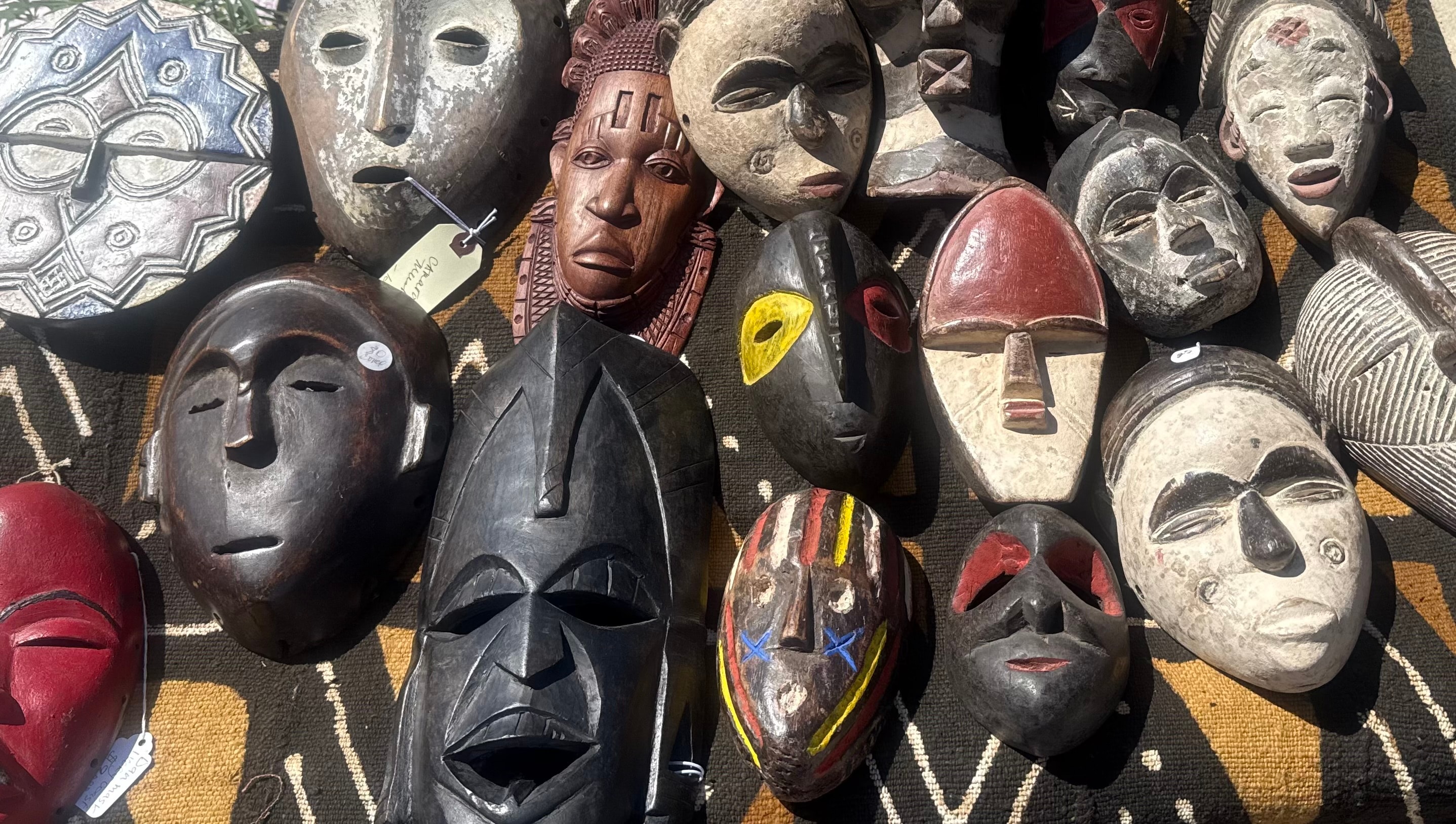
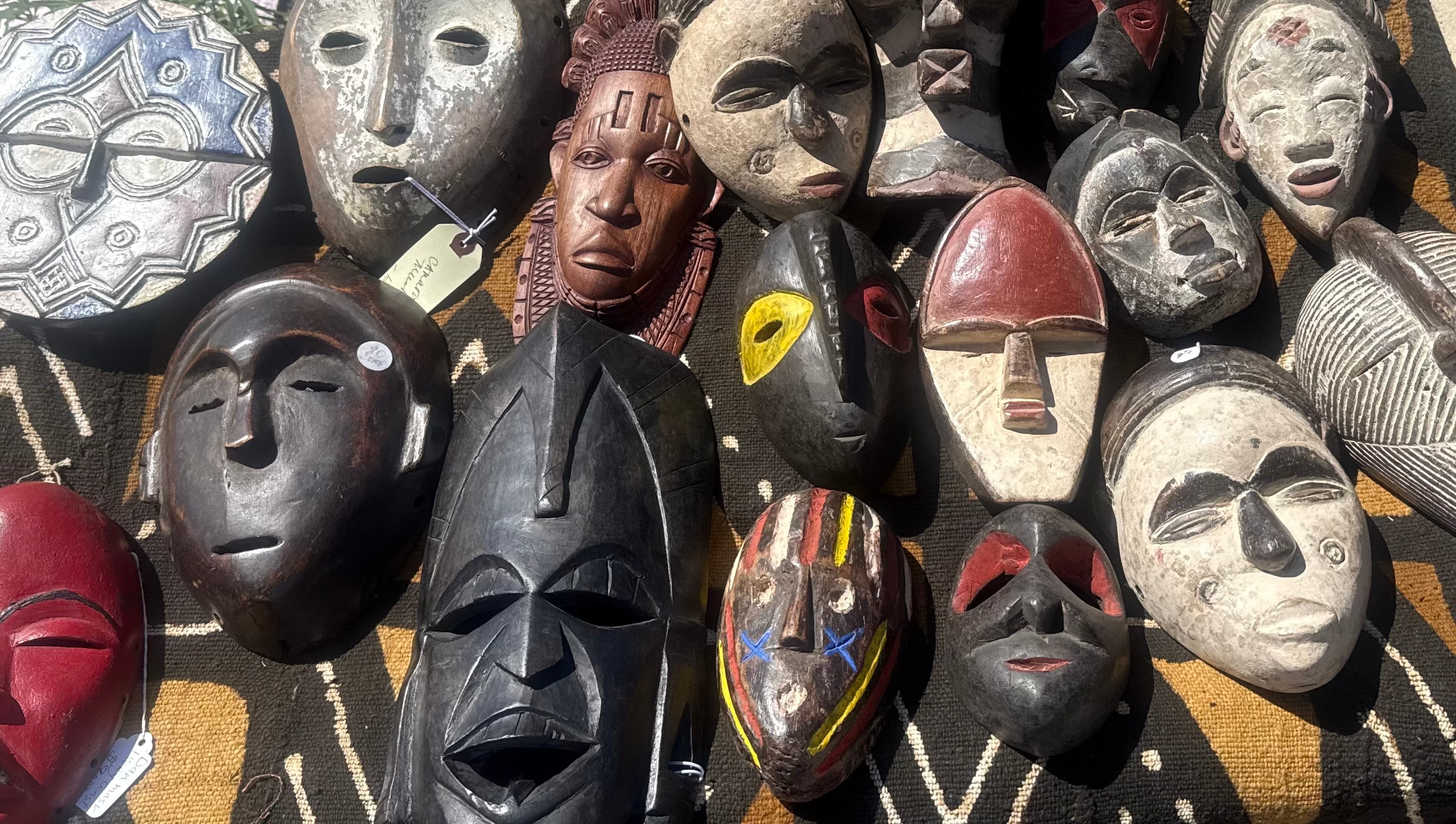
Collection of African tribal masks representing ancestral heritage and cultural identity
Legacy Preservation Project

Heritage Is Not Where "YOU" Started.It's Where Your People, Originated.

Legacy begins at home — not in a corporate boardroom, not on a college campus,  and not in a sports arena. Your family's beginning also started at the beginning of human civilization itself — and it has been worth preserving ever since.

What Is Heritage?

And why does it matter more than most people realize?

Heritage is the living record of who your people have always been. It is the sum of your family's knowledge, culture, land, language, spiritual practice, and documented history — passed from generation to generation not as a trophy, but as a foundation. It is the answer to the question every child eventually asks: Where do I come from?

Heritage is not wealth. It is not the surname on the side of a building or VIP seating at the country club. Some of the most powerful and documented family legacies in human history belong to people who owned nothing but their story — and that story was enough to sustain their descendants through centuries of displacement, reclassification, and erasure.

Heritage gives a family its identity, its continuity builds legacy, and its standing promotes raw organic power— not in the eyes of the powerful, but in the eyes of each human, one experience at a time.  When you know where you come from, you know who you are; and when you know who you are, no one can tell you otherwise.

Anthropological Classification

The Three Primary Racial Stocks of Humanity

Before the politics of erasure, science recognized three primary racial stocks of humanity. These are not slurs — they are the formal anthropological terms used in every major academic institution, census record, and government document from the 18th through the 20th century. Knowing them is not optional. It is the foundation of understanding your documented lineage.

NegroidCaucasoidMongoloid
Negroid
African Racial Stock

The formal anthropological designation for peoples originating from the African continent. Characterized in historical classification by dark melanated skin, tightly coiled hair, and broad nasal structure — features developed over tens of thousands of years in equatorial climates. The Negroid stock is the oldest of the three, representing the root of all human genetic lineage.

This term appears throughout U.S. census records, Dawes Rolls, Freedmen documentation, and colonial-era legal instruments. Understanding it is essential to reading your own family's paper trail accurately.

★ LPP NOTE — ON THE WORD "NEGRO"

Just as "Negro" and "Negroid" are not the same word... Same applies to Mongol & Mongoloid. One word weaponized as a social label, the other is a scientific classification. Conflating the TWO, is how erasure works.

In Academia today, the terms "Negroid" and "Mongoloid" have been erased from our educational system. (Google it. See the erasure in real time). These historical racial identifiers have been labelled derogatory and are considered no longer valid and have been changed many times.  However, the word "Caucasian" remains active and in use by U.S. legal, medical, and census contexts to this day and has not changed — Caucasoid has NOT been identified as a racial slur and that double standard is not an accident.

Caucasoid
European & Eastern European Racial Stock

The formal anthropological designation for peoples originating from Europe,  and specifically Eastern Europe. Named after the Caucasus mountain region, which 18th-century anthropologist Johann Friedrich Blumenbach identified as the geographic origin point of this stock. Characterized historically by light to pale skin tones, straight to wavy hair, and narrow nasal structure.

Caucasoid ancestry appears throughout colonial American records, particularly in the documentation of Free People. The Melungeon communities, and mixed-heritage families were legally classified by European standards and bloodline, regardless of their full ancestry.

★ LPP NOTE — MELUNGEON

The Melungeon community is one of the most documented triracial isolate groups in American history — concentrated in the Appalachian highlands of Virginia, Tennessee, and Kentucky. They were a people of mixed Indigenous, European, and African descent who formed tight-knit, self-sustaining communities in the mountains, largely outside the reach of the plantation economy. Colonial and antebellum records variously classified them as Portuguese, free Negro, mulatto, or simply "other" — depending on who was doing the counting and what legal consequences that classification carried. Melungeon families were frequently stripped of voting rights, land titles, and legal standing as racial laws hardened in the 1830s–1850s. Their story is a direct example of forced ethnogenesis: a people with a specific, layered identity reduced to a catch-all administrative label that served the state, not the truth.

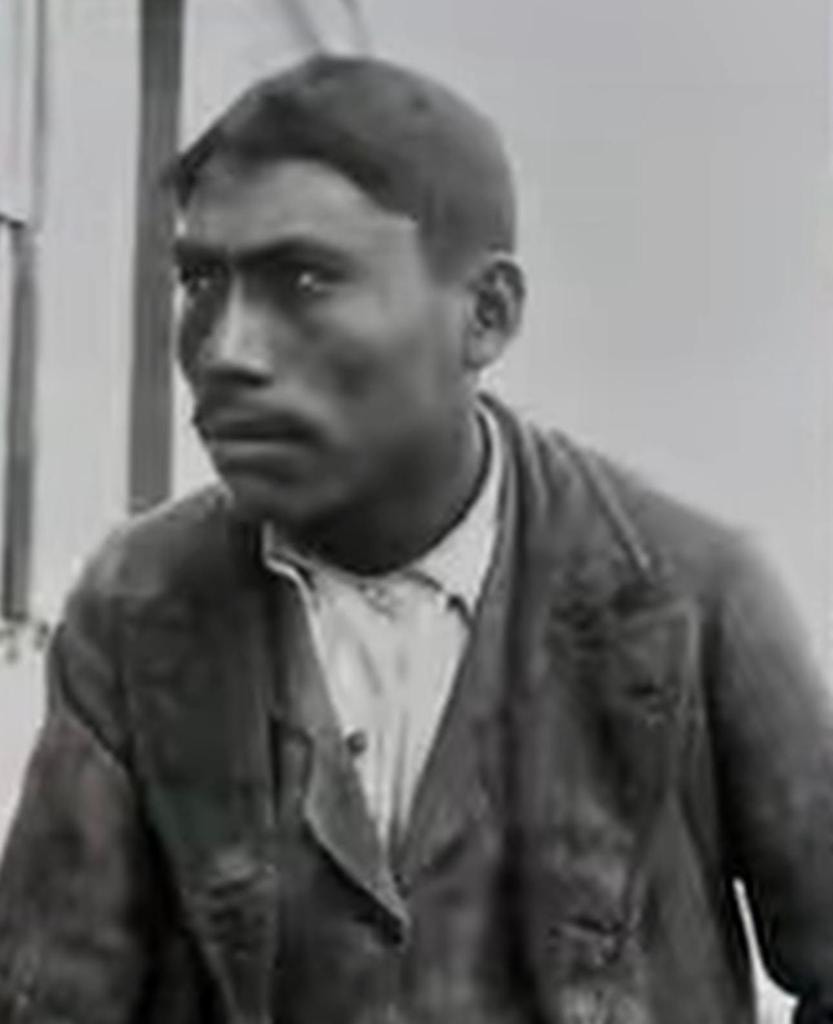
Melungeon man — Appalachian triracial community

Melungeon man — Appalachian triracial community. View in Gallery →

Mongoloid
North, Central, South Americas, Asia, Australia Pacific islands, Europe / Siberia Racial Stock.

The formal anthropological designation for peoples originating from East Asia, Central Asia, the Americas, and the Pacific Islands. Named after the Mongol peoples of Central Asia, this classification encompasses the broadest geographic range of the three stocks — including all Indigenous peoples of North and South America, who migrated from Asia across the Bering land bridge thousands of years before European contact.

This is why many Indigenous ancestries — Tonkawa, Cherokee, Comanche, or any other tribal  nation — appears in historical records under Mongoloid classification. It is not an insult. It is the scientific record of who these people are and where they originated. It is also worth noting that the Siberian peoples — and by extension many Europeans whose ancestry traces through Central Asia — carry darker complexions not solely because of climate, but because of the elevation. High-altitude populations develop deeper pigmentation as a biological response to increased UV radiation at altitude. They, too, belong to this stock. They cannot be forgotten.

★ LPP NOTE — ON THE WORD "MUNGLES"

Like, "Negro" and "Negroid" are not the same word. One, weaponized as a social label. The other is a scientific classification. The same goes for the racial stock Mongoloid .  Ever heard... "Those Mungles?"  The pronoun "Mungles" is derogatory and a corrupted version of the term Mongoloid. It is commonly used as a racial slur — carrying the same dehumanizing intent as the most violent anti-Negroid slurs in American history. It was designed to mock and diminish the Indigenous, those who are native or aboriginal peoples, by weaponizing the legitimate scientific terms. The word Mongoloid as well as Negroid are not slurs. The slur is what was done to it. Knowing the difference is how you protect your family's documented identity from being erased a second time.

Every original melanated Indigenous person to the Americas and on earth, carries either or both Mongoloid and Negroid phenotypes for the historical record. That is not erasure — that is the paper trail that proves many colors of peoples were already here.

These three classifications — Negroid, Caucasoid, and Mongoloid — are not relics of hatred. They are the vocabulary of the historical record. Census takers used them. Courts used them. The Dawes Commission used them. If your family appears in any official document from the 1700s through the mid-1900s, these words describe your ancestors. Refusing to learn them does not protect your family. It leaves their story unread.

The Language of Colonial Classification

The Language of Colonial Classification

To reclaim heritage, you must first understand the vocabulary that buried it. The following terms appear throughout census records, church registers, land grants, and court documents from the colonial and antebellum periods. Each one represents a real family whose actual ancestry was reduced to an administrative label.

Free People of Color

(FPOC)

A legal designation used in the antebellum South for individuals of African, Indigenous, or mixed descent who were not enslaved. FPOC communities were legally distinct from both enslaved people and white citizens — they could own property, enter contracts, and in some jurisdictions vote — but their racial classification was fluid and subject to reclassification at any time. Many FPOC families carried significant Indigenous ancestry that was systematically erased as racial binary laws hardened after 1830.

Mestizo

In Spanish colonial records, Mestizo designated a person of mixed Indigenous, African, and Spanish European descent — though the Spanish Crown originally intended the term to apply only to Indigenous and European mixture. African ancestry was deliberately excluded from the casta definition. That exclusion was by design: a calculated act of separation meant to rank, divide, and erase. But history did not honor that boundary. The term was part of the elaborate casta system that assigned hierarchical social status based on perceived racial mixture. In practice, 'Mestizo' obscured the specific Indigenous national identity of the non-European parent — a Comanche, Caddo, or Coahuiltecan person became simply 'Indio' or 'Mestizo' in the record, severing the connection to a specific nation that tribal citizenship requires. Today, people of African, Indigenous, and European descent are recognized as Mestizo, reflecting the true complexity of what colonial mixing produced. That African thread will not be erased here. It is part of this record.

Creole

Creole carried different meanings in different colonial contexts. In Louisiana and the Gulf Coast, it designated people of French or Spanish colonial descent — sometimes mixed, sometimes not. In practice, 'Creole' was used to describe mixed-heritage families of African, Indigenous, and European descent who maintained distinct cultural identities, spoke French or Spanish Creole languages, and often held property. Many Creole families in East Texas and Louisiana carried Indigenous ancestry from Gulf Coast nations including the Atakapa, Caddo, and Chitimacha.

Mustee

Mustee (also Mustizo, Mustifee) was a colonial classification for a person of mixed Indigenous and African descent, or sometimes Indigenous and European descent. The term was used primarily in the Carolinas, Virginia, and Georgia — the precise corridor from which many East Texas families migrated. Mustee families were frequently reclassified as 'Negro' or 'Mulatto' within one or two generations, erasing the Indigenous component of their ancestry from the documentary record entirely.

Sambo

In colonial classification systems, 'Sambo' designated a person of mixed African and Indigenous descent — specifically, in some jurisdictions, three-quarters African and one-quarter Indigenous, or some similar fractional formulation. Like all colonial racial fractions, these designations were not scientific measurements. They were administrative fictions. Families classified as Sambo frequently carried significant Indigenous ancestry from specific nations — ancestry that is recoverable through pre-classification records, oral history, and DNA analysis.

Negro

As a colonial and antebellum classification, 'Negro' was applied broadly and often inaccurately to anyone with visible African ancestry — regardless of their actual ethnic composition. Census enumerators frequently reclassified families who had previously appeared as 'Free Colored,' 'Mustee,' or 'Indian' as 'Negro' in subsequent census years. This reclassification was not a reflection of changed ancestry. It was a reflection of changed political conditions — specifically, the hardening of racial binary law in the decades before the Civil War.

Historical Context

Free People of Color in East and Central Texas

circa 1800 — The Community at the Crossroads

By the turn of the nineteenth century, East and Central Texas was one of the most ethnically complex regions in North America. It sat at the intersection of three colonial empires — Spanish, French, and nascent American — and was home to dozens of Indigenous nations, established Mestizo and Creole communities, and a significant population of Free People of Color whose origins traced back through Louisiana, the Carolinas, Virginia, Georgia and the Gulf Coast trade networks.

These were not marginal communities. FPOC families in East Texas owned land under Spanish colonial grants, operated farms and ranches, participated in the hide and tallow trade, and maintained kinship networks that stretched from Nacogdoches to Natchitoches to New Orleans. Many held Indigenous ancestry from Gulf Coast and Southeastern nations — Caddo, Atakapa, Coushatta, Cherokee, and others — alongside African and European lineages.

The political transitions of the early 19th century — from Spanish to Mexican rule in 1821, and from Mexican to Republic of Texas in 1836 — each brought new classification pressures. Families who had been legally recognized as free landowners under Spanish law found their status challenged, their land grants contested, and their racial classifications revised. The documentary record of this period is rich, complex, and largely unexamined — and it is precisely where the Legacy Preservation Project focuses its research.

Our volunteer specialists have deep expertise tracing family lines, Kin/Slaves and migration patterns, from Virginia, Tennessee, through the Carolinas and Georgia into Louisiana and East Texas — the primary migration corridor for FPOC, Mustee, and triracial families in the antebellum period.

Our Area of Expertise

The Virginia-to-Texas Migration Corridor

Where Our Expertise Is Deepest — Including Spanish Texas & Mexico

The movement of Free People of Color, Mustee families, and mixed-heritage communities from the Virginia Tidewater through Tennessee, the Carolinas, Georgia, and Alabama into Louisiana and East Texas represents one of the most significant and least-documented migrations in American history. It unfolded over roughly a century — from the late 1700s through the 1850s — driven by a combination of economic pressure, legal restriction, and the westward expansion of the cotton economy.

It is critical to understand that in the early 1800s, "Virginia territory" was not confined to the modern state boundary. For Indigenous peoples and their kin — including enslaved and free mixed-heritage families — Virginia's reach extended westward to the Mississippi River and into parts of the Midwest. Much of this vast interior was Indian Territory, home to sovereign nations whose land, kinship networks, and people are inseparable from the story of families who later appeared in Texas records.

This corridor is where the Legacy Preservation Project's research expertise is deepest — from Virginia county records, Quaker manumission documents, and colonial land grants, through Tennessee settlements, Carolina tax lists, and Georgia land lotteries, into Louisiana territorial records, Texas land grants, and the complex archives of the Republic of Texas period. Our research extends into Spanish Texas and into Mexico and Central America, where many of these same bloodlines continued, intermarried, and survived erasure under entirely different colonial systems.

Migration Corridor
Virginia Territory
Tidewater origins, manumission records, colonial land grants — territory extending to the Mississippi River and into the Midwest, encompassing vast Indian Territory
Tennessee
Cherokee and Chickasaw nation records, mixed-heritage settlements, overland migration routes westward
North & South Carolina
Mustee communities, Lumbee corridor, tax lists, triracial isolate communities
Georgia & Alabama
Land lotteries, Creek and Cherokee Nation records, migration routes south and west
Louisiana
French colonial archives, Creole communities, Natchitoches records
East & Central Texas
Spanish land grants, Republic of Texas records, Nacogdoches archives, Freedom Colony settlements — Tonkawa, Caddo, and Karankawa homelands
Spanish Texas — Viesca (Milam)
Pre-Republic Spanish and Mexican colonial land grants, Viesca colony records, Indigenous and mixed-heritage families who held land before Texas statehood — our ancestral ground
Mexico & Central America
Colonial New Spain archives, Mestizo and Indigenous bloodlines that crossed into Texas and back, families whose story spans both sides of a border that did not yet exist

Why It Matters

Heritage reclamation is not nostalgia. It is a legal, cultural, and deeply personal act of restoration with real-world consequences.

Tribal Citizenship & Sovereignty

Many Indigenous nations require documented lineage for citizenship. Reclaiming that documentation is the first step toward exercising rights that were never legally extinguished — only buried.

Cultural Continuity

Language, ceremony, land knowledge, and kinship systems cannot be transmitted across a gap that was never acknowledged. Reclamation closes that gap.

Historical Accuracy

The historical record was written by those with power to define others. Heritage reclamation corrects that record — not with sentiment, but with evidence.

Intergenerational Healing

Identity fracture is a form of inherited trauma. Restoring ancestral knowledge to a family line is an act of healing that extends forward as well as backward.

The Motherland & The Fatherland

The Erasure & Validation of the Negroid and Mongoloid

Ancient Egypt — pyramids and civilization along the Nile, the cradle of human heritage

Ancient Africa

Egypt · Nubia · Aksumite Empire · Nile Civilization

Ancient Sumeria — Mesopotamia, the cradle of written language and law

Ancient Sumeria

Mesopotamia · Tigris & Euphrates · First Written Law

All roads lead to Africa, the Fertile Crescent, and the Middle East. The scientific and archaeological record is unambiguous: all human life originated on the African continent. The earliest known civilizations — Egypt along the Nile, Nubia, Ethiopia to its south, Carthage to its north, the Aksumite Empire in the east — were African civilizations. The mathematics, astronomy, architecture, medicine, and governance systems that the Western world claims as its own inheritance were first developed by African peoples.

Sumeria — the land between the Tigris and Euphrates rivers in modern-day Iraq — gave the world its first written language, its first codified legal system, and its first recorded history. These were not primitive peoples. They were the architects of civilization itself. Persia, rising from this same ancient world, gave humanity its first declaration of human rights under Cyrus the Great. These are not footnotes. They are the foundation.

The Three Original People — Negroid, Caucasoid & Mongoloid

The three ancient racial classifications that defined all of humanity — and were quietly erased except for one.

For generations, academia recognized three ancient racial classifications that described the full breadth of human origin: Negroid, Caucasoid, and Mongoloid. These were not slurs when first recorded — they were the scholarly framework used to acknowledge that humanity had three distinct ancient stocks. Today those terms have been declared derogatory and quietly erased from academic language. But erasing the words does not erase the truth they pointed to. It simply leaves people without a vocabulary to claim where they came from.

The Mongoloid stock — the brown, red, and yellow peoples of the ancient world — is the most overlooked and the most deliberately obscured. Consider this: the world is two-thirds melanated people. Not all of them came from Africa. Ancient America / Mesoamerica — two entire continents — were already populated by dark, red, brown, and yellow peoples long before any European ship crossed any ocean. The Indigenous nations of North, Central, and South America were not a footnote to world history. They were world history.

These three ancient stocks have been hijacked — reclassified, renamed, diluted, and in some cases erased entirely from the public record. The Negroid classification was buried under the politics of the civil rights era. The Mongoloid classification was quietly retired without replacement. And the Caucasoid classification was elevated and centered as the default of humanity. This was not an accident of language. It was a restructuring of identity — one that left billions of people without a framework to understand their own ancient origins.

When colonial powers stripped African, Indigenous, and Semitic peoples of their documented identities, they were not just erasing names on a census. They were severing families from a heritage that predates every European nation-state by thousands of years — a heritage rooted in Africa, in the Fertile Crescent, and in the ancient Americas. That severance was intentional and CAN BE REPAIRED!!!

Why It Matters

Why Preserve Heritage?

Because what was taken deliberately must be reclaimed deliberately. Heritage preservation is not nostalgia — it is an act of resistance, identity, and love.

🌱

It Builds Identity

Children who know their family history have measurably higher self-esteem, resilience, and sense of purpose. Heritage is not a luxury — it is a psychological foundation. Knowing where you come from tells you who you are allowed to become.

⚖️

It Confers Legal Standing

Documented heritage is not just personal — it is evidentiary. Tribal citizenship, land claims, inheritance rights, and federal recognition all depend on documented lineage. Your family's story, properly preserved, is a legal instrument.

🔗

It Connects Generations

Heritage is the thread that runs from your great-great-grandmother's name on a census record to your grandchild's sense of self. When that thread is cut — by erasure, reclassification, or neglect — every generation downstream pays the cost.

🛡️

It Cannot Be Taken Twice

Once your family's heritage is documented, verified, and preserved, it cannot be administratively erased again. The Legacy Preservation Project exists to make that documentation permanent — so that what happened to your ancestors cannot happen to your descendants.

Diverse multigenerational family celebrating together

"Not everything that is faced can be changed, but nothing can be changed until it is faced."

— James Baldwin

The Reinvention Industry

Wealthy families have always known that heritage is power — so they manufactured it.

Here is something the history books rarely say plainly: the families most associated with "old money" and "legacy" in America did not inherit their status from ancient nobility. They built it — often through exploitation, land theft, and the deliberate erasure of the people whose labor and land made their wealth possible. And then they hired historians, endowed universities, and named buildings to make it look inevitable.

Consider the Trumps: Fred Trump built his real estate empire in part through federally subsidized housing programs while simultaneously refusing to rent to Black families — a practice documented in federal lawsuits. The family's "legacy" is a carefully curated brand, not an ancient lineage. The Vanderbilts, the Rockefellers, the Carnegies — these families did not inherit civilizational heritage. They purchased the appearance of it.

Meanwhile, families with genuine, documented lineages stretching back to the Free People of Color of colonial Virginia, to the Cherokee freedmen, to the Melungeon communities of Appalachia — families with real heritage — were told by the state that their history did not exist. Walter Plecker made sure of it.

"You do not need a trust fund to have a legacy. You need a record. And the Legacy Preservation Project helps you build one."

The difference between a family that "has legacy" and one that doesn't is not wealth — it is documentation. It is the willingness to look, to find, and to preserve what is already there. That work is available to every family, regardless of income. And it is exactly what we do.

A Note to the Community

Legacy Starts at Home

Across every culture and class, institutions have claimed ownership of the word legacy. Universities tell you it means your grandfather walked the same campus. Fraternities and sororities — Black and white alike — tell you it means wearing the same letters. Secret societies tell you it means carrying the same handshake across generations. Corporations tell you it means inheriting a seat at the table. Religious organizations tell you it means continuing a denominational tradition. And none of that is without meaning. community, brotherhood, sisterhood, shared ritual — these things matter.

But not one of those institutions is where your legacy begins.

Your legacy began long before any institution was founded, any charter was signed, or any secret was sworn. It began in the home — in the family. In the grandmother who kept the name alive. In the grandfather who held land no one recorded in his favor. In the ancestor who survived a crossing, a removal, a reclassification, a war — and still made sure the next generation knew who they were. That is not a chapter in someone else's story. That is the story.

The organization is a chapter.
The family tree is the Entire Book —
which makes us who we ultimately ARE.

Black college women celebrating legacy and sisterhoodElder passing wisdom to the next generation

What Erasure Actually Costs

The damage is not just historical. It is psychological, legal, and generational.

When a family's heritage is erased — through colonial reclassification, through Walter Plecker's paper genocide, through the deliberate destruction of records — the damage does not stop with the generation that lived through it. It compounds. Children grow up without answers to the most fundamental questions of identity. Families lose the legal standing that documented lineage provides. Communities lose the cohesion that comes from shared, verified history.

Research in developmental psychology consistently shows that children with a strong sense of family history — what researchers call a "strong intergenerational narrative" — demonstrate greater resilience, higher academic achievement, and stronger mental health outcomes. Heritage is not a luxury. It is a protective factor. And its absence is a wound.

This is not an abstraction for the communities the Legacy Preservation Project serves. The families who come to us are not looking for a hobby. They are looking for the piece of themselves that was taken. They are looking for the name their great-grandmother used before the census enumerator wrote something else. They are looking for the nation their ancestor belonged to before the state decided it was inconvenient.

Lost tribal recognition

Families with documented Native ancestry denied citizenship due to reclassified records

Severed land rights

Heirs unable to claim ancestral land because their lineage was administratively erased

Identity displacement

Generations raised without knowledge of their true national and ethnic heritage

Recoverable

With the right methodology, most erased heritage can be documented and restored

Your Heritage Is Waiting to Be Found

You do not need wealth to preserve your family's legacy. You need documentation, methodology, and the willingness to look. The Legacy Preservation Project provides all three — for families at every income level, from every background, at every stage of their research.

Foundational Concept

What Is Ethnogenesis?

The Making — and Unmaking — of a People

Ethnogenesis is the scholarly term for the process by which a new ethnic or cultural identity forms — typically through the merging of previously distinct peoples under conditions of migration, colonization, or sustained contact. In the context of colonial America, ethnogenesis was not a natural or voluntary process. It was imposed.

When Spanish, French, and English colonial powers encountered the diverse nations of the Americas and the African peoples they enslaved and transported, they did not record what they found. They recorded what was administratively convenient. Indigenous nations with distinct languages, governance structures, and territorial identities were collapsed into a single category. African peoples from dozens of nations and ethnic groups were stripped of national identity entirely. Mixed-heritage children born of these encounters were assigned classifications that served the colonial economy — not the truth of their ancestry.

"Ethnogenesis in colonial America was not the birth of new peoples. It was the erasure of old ones — replaced by categories that served the state, not the truth."

The result was a forced ethnogenesis: the creation of new racial categories — 'Indian,' 'Negro,' 'Mulatto,' 'Mestizo,' 'Free Colored' — that replaced the specific national and ethnic identities of real people. These categories were not descriptions. They were administrative instruments of control. And they are the categories that most families are still trying to see through today.

Why This Matters for Your Family

The administrative record is not the final word on who you are.

Understanding ethnogenesis is the first step in heritage reclamation. When you know that the category on your ancestor's census record was imposed — not chosen — you can begin to look past it. The specific national and ethnic identities that colonial classification erased are often still recoverable through pre-classification records, oral history, DNA analysis, and cross-referencing of documentary sources.

The Legacy Preservation Project specializes in exactly this work. Our researchers are trained to read colonial records against the grain — to see through the administrative category to the real person, the real family, and the real nation that the record was designed to obscure.

The Instruments of Erasure

Racial Identity Markers

Each term below is a social identity marker — assigned by colonial administrators, census enumerators, and legal systems to serve the state. None of them describe who a person actually was. Understanding how each category was used is the first step toward seeing through it.

Indian / Indio

Colonial Label

Collapsed dozens of sovereign nations — each with distinct languages, governance, and territorial identity — into a single administrative label. Used interchangeably across Spanish, French, and English records regardless of the specific nation of the individual. A Caddo, Comanche, or Coahuiltecan person became simply "Indian" in the record, severing the connection to a specific nation that tribal citizenship requires.

Negro

Colonial Label

Applied broadly to anyone with visible African ancestry, regardless of actual ethnic composition. Census enumerators frequently reclassified families who had previously appeared as Free Colored, Mustee, or Indian as Negro as racial binary laws hardened after 1830. This reclassification was not a reflection of changed ancestry — it was a reflection of changed political conditions.

Mulatto

Colonial Label

Designated a person of mixed African and European descent — but in practice was applied inconsistently and often used to reclassify families with significant Indigenous ancestry. The category served the legal system, not biological reality. Many families recorded as Mulatto carried tribal lineage that was deliberately obscured by this designation.

Mestizo

Colonial Label

In Spanish colonial records, designated mixed Indigenous and Spanish European descent within the elaborate casta system. Obscured the specific Indigenous national identity of the non-European parent — a Comanche, Caddo, or Coahuiltecan person became simply Indio or Mestizo in the record, erasing the nation-specific ancestry that descendants need to establish lineage today.

Free Colored

Colonial Label

A legal designation for individuals of African, Indigenous, or mixed descent who were not enslaved. FPOC status was legally precarious — subject to reclassification at any time as racial binary laws tightened in the antebellum period. Many FPOC families carried significant Indigenous ancestry that was systematically erased as the racial binary hardened after 1830.

Mustee / Mustizo

Colonial Label

In Southern dialect, 'Mustee' is a variation of Mestizo — the same word, worn down by the tongue of a different colony. A colonial classification for a person of mixed Indigenous and African descent, used primarily in the Carolinas, Virginia, and Georgia — the precise corridor from which many East Texas families migrated. Mustee families were frequently reclassified as Negro or Mulatto within one or two generations, erasing the Indigenous component of their ancestry from the documentary record entirely.

Creole

Colonial Label

Carried different meanings across colonial contexts. In Louisiana and the Gulf Coast, it designated people of French or Spanish colonial descent — sometimes mixed, sometimes not. In practice, Creole described mixed-heritage families of African, Indigenous, and European descent who maintained distinct cultural identities. Many Creole families in East Texas and Louisiana carried Indigenous ancestry from Gulf Coast nations including the Atakapa, Caddo, and Chitimacha — ancestry the Creole label obscured rather than preserved.

Pardo

Colonial Label

A Spanish colonial casta classification designating a person of mixed African, Indigenous, and European descent — roughly equivalent to the English "Mulatto" but used across Spanish-controlled territories including Texas, Louisiana, and Florida. Pardo was an administrative convenience, not an ethnic identity. Families classified as Pardo often carried specific Indigenous national ancestry from Gulf Coast and interior nations that the label collapsed into a single, legally manageable category.

Black

Colonial Label

As a post-Reconstruction social and legal identity marker, "Black" consolidated the earlier colonial categories — Negro, Mulatto, Free Colored, Mustee — into a single racial designation under the one-drop rule. Families with mixed Indigenous, African, and European ancestry were absorbed into a Black racial identity that, while culturally significant and politically hard-won, often obscured the specific tribal and national lineages that had been deliberately erased in the preceding century of colonial classification.

African American

Colonial Label

A contemporary identity term that honors the African heritage and American experience of descendants of enslaved and free Black people. As a social identity marker, it is chosen — not imposed — and carries profound cultural and political meaning. However, for families engaged in heritage reclamation, African American identity does not preclude Indigenous ancestry. Many African American families carry documented tribal lineage that was erased by colonial classification and can be recovered through archival research, DNA analysis, and the methodology of the Legacy Preservation Project.

The Smoking Gun

The Architect of Erasure

One man. One office. Thirty-four years. Thousands of families erased from the record — by design.

Walter Ashby Plecker

Harvard-trained eugenicist · Virginia Registrar of Vital Statistics, 1912–1946

Walter Ashby Plecker, Virginia Registrar of Vital Statistics

Archival representation — period era

34
Years in Office
Thousands
Records Altered
11+
Tribes Erased
Racial Integrity Act 1924
Virginia Law

"I am glad to say that we have in Virginia the most perfect and complete system of racial registration of any state in the Union."

— Walter A. Plecker, 1925

Who He Was

Walter Ashby Plecker (1861–1947) was a physician trained at the University of Maryland and a devoted disciple of the American eugenics movement — the same pseudoscientific ideology that later inspired Nazi Germany's racial laws. In 1912, he was appointed the first Registrar of Virginia's Bureau of Vital Statistics, a position he held for 34 years. He used that office as a weapon.

What He Did

Plecker used his position to systematically reclassify Virginia's Indigenous and mixed-heritage families as "colored" — erasing their tribal identities from the official record. He personally wrote letters to county clerks, hospital administrators, and school officials instructing them to reject any birth certificate, marriage license, or school enrollment that claimed Indigenous identity. He called this campaign "paper genocide."

Why It Matters Now

Plecker's campaign was Virginia-specific, but the pattern was national. Similar reclassification efforts occurred in Texas, Louisiana, North Carolina, and across the South. The families affected by these campaigns are still living with the consequences — denied tribal citizenship, stripped of documented heritage, and left with records that actively lie about who their ancestors were. The Legacy Preservation Project exists to undo that lie, one family at a time.

Journalism & Documentation

In the Record

Real stories. Real families. Real stakes. A curated dispatch of journalism covering mixed-heritage communities, Freedmen citizenship battles, and the ongoing fight for tribal recognition across Indian Country.

News You Can Use

The legal, cultural, and political struggles of mixed-heritage families are not historical footnotes — they are unfolding right now in federal courts, tribal councils, and state legislatures. The Legacy Preservation Project tracks this coverage because what happens in Indian Country today directly affects the families we serve. These stories are not abstractions. They are the living context of heritage reclamation.

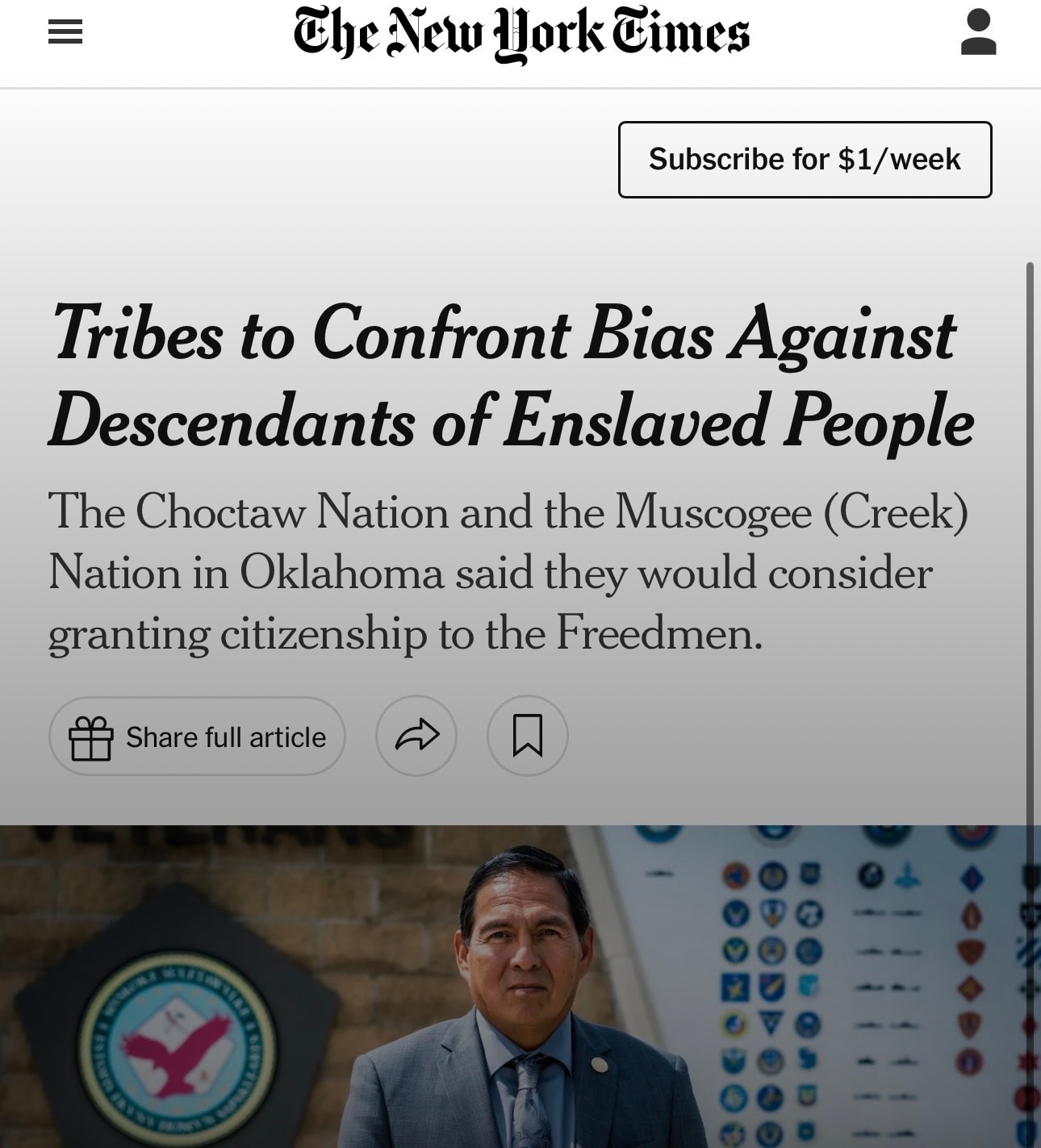
Tribes to Confront Bias Against Descendants of Enslaved People
Tribal CitizenshipThe New York Times· 2024

Tribes to Confront Bias Against Descendants of Enslaved People

The Choctaw Nation and the Muscogee (Creek) Nation in Oklahoma said they would consider granting citizenship to the Freedmen — descendants of people enslaved by tribal members who were driven west along the Trail of Tears.

LPP Note: This story sits at the heart of what we do. Freedmen descendants have documented lineage to tribal nations. The question has never been ancestry — it has always been political will.

Read the full article
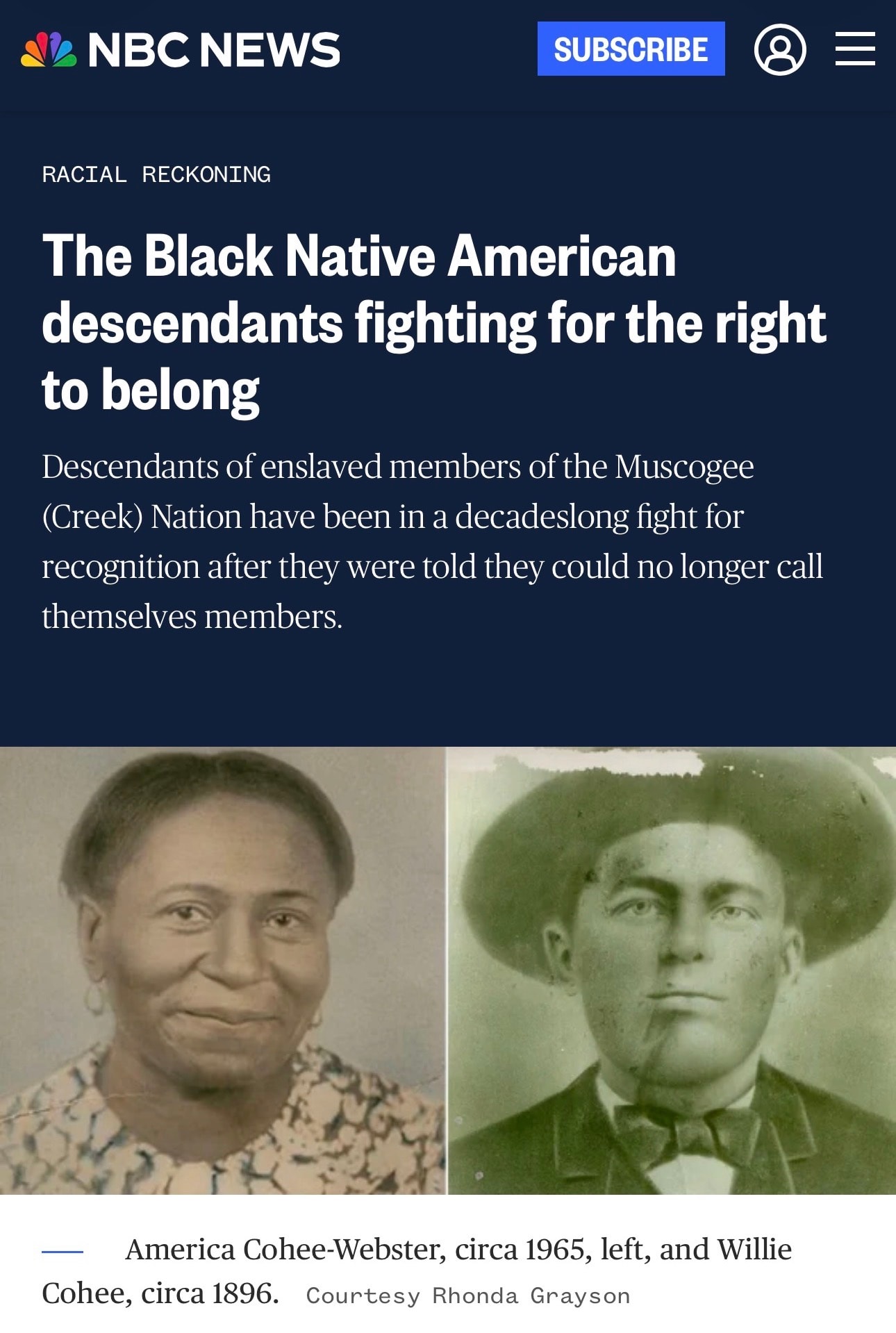
The Black Native American Descendants Fighting for the Right to Belong
Racial ReckoningNBC News· 2023

The Black Native American Descendants Fighting for the Right to Belong

Descendants of enslaved members of the Muscogee (Creek) Nation have been in a decadeslong fight for recognition after they were told they could no longer call themselves members.

LPP Note: The Cohee-Webster family's story is a case study in what colonial misclassification does across generations. Documented ancestry, severed recognition — this is exactly the pattern the Legacy Preservation Project exists to address.

Read the full article
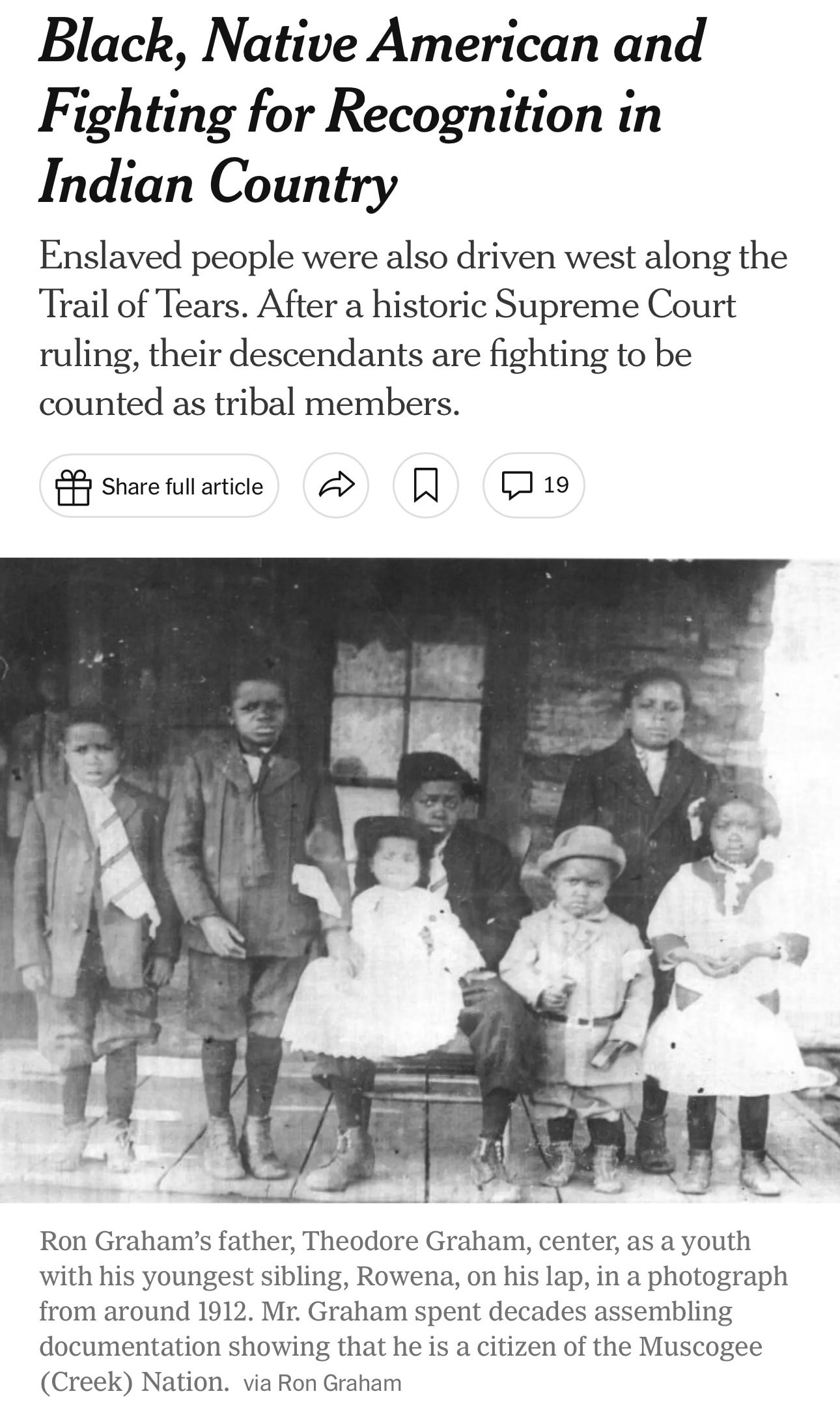
Black, Native American and Fighting for Recognition in Indian Country
Trail of TearsThe New York Times· 2022

Black, Native American and Fighting for Recognition in Indian Country

Enslaved people were also driven west along the Trail of Tears. After a historic Supreme Court ruling, their descendants are fighting to be counted as tribal members.

LPP Note: Ron Graham spent decades assembling documentation proving his citizenship in the Muscogee (Creek) Nation. His story illustrates why the evidentiary chain matters — and why the Legacy Preservation Project's methodology is built around exactly that kind of documentation.

Read the full article
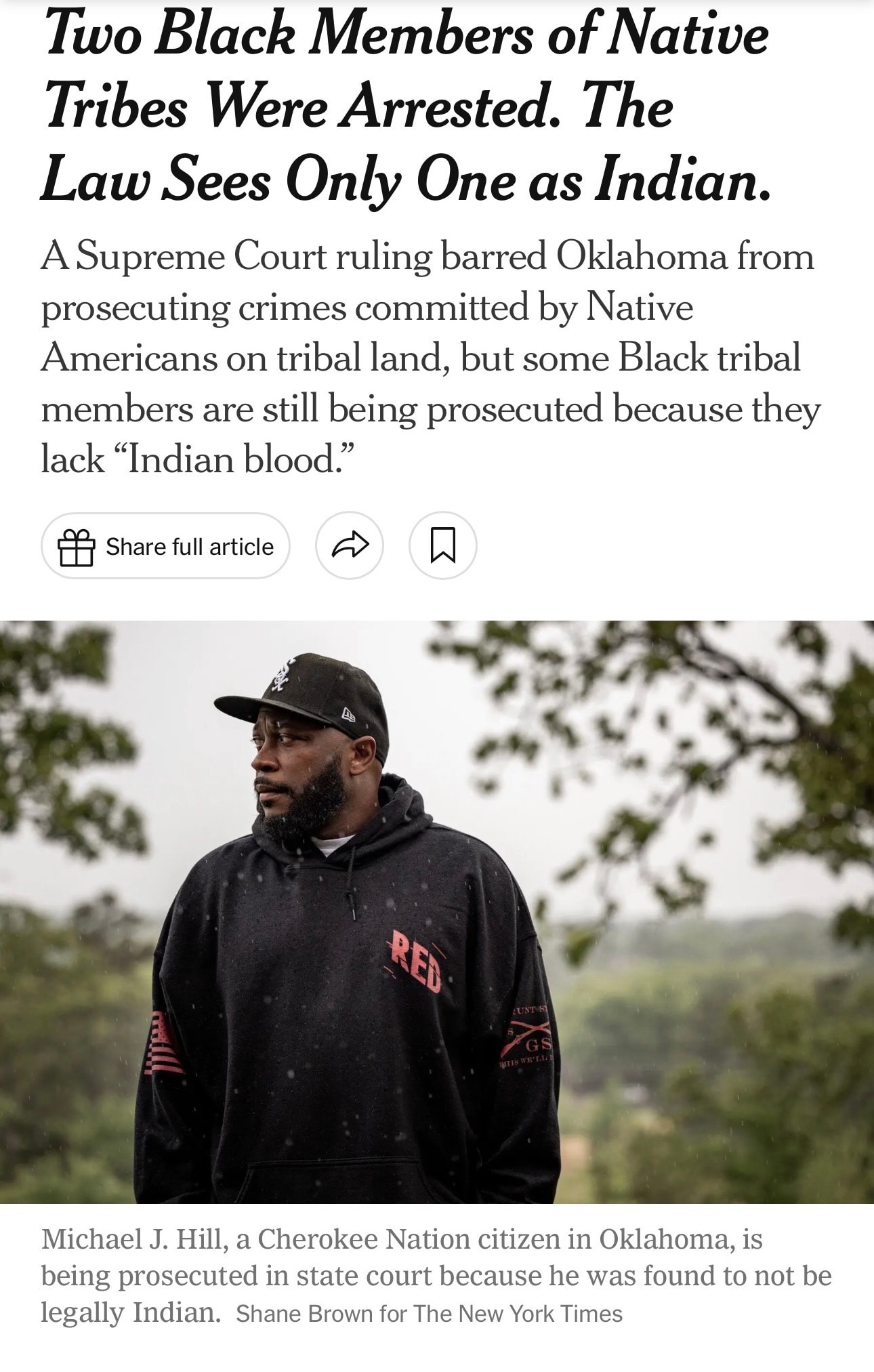
Two Black Members of Native Tribes Were Arrested. The Law Sees Only One as Indian.
Tribal ProsecutionThe New York Times· 2022

Two Black Members of Native Tribes Were Arrested. The Law Sees Only One as Indian.

A Supreme Court ruling barred Oklahoma from prosecuting crimes committed by Native Americans on tribal land, but some Black tribal members are still being prosecuted because they lack 'Indian blood.'

LPP Note: Michael J. Hill is a Cherokee Nation citizen. The state of Oklahoma prosecuted him anyway because the law still uses blood quantum as a proxy for identity — the same colonial logic that misclassified his ancestors. This is what is at stake when heritage documentation is incomplete.

Read the full article
Legacy Preservation Project

Honoring the past. Protecting what matters. Reconnecting families to the nations they descend from.

Communities We Serve

  • Indigenous & Tribal Nations
  • Free People of Color (FPOC)
  • Mestizo & Mixed-Heritage Families
  • Families Affected by Colonial Erasure

Our Organization

recipe4parenting.com

RECIPE INC — our parent 501(c)(3) nonprofit organization

The Legacy Preservation Project operates as a program of RECIPE INC, a registered 501(c)(3) organization.

© 2026 Legacy Preservation Project — C.A.M. Provenzano. All rights reserved.
Unauthorized reproduction, distribution, or use of any content, research, photographs, or written material from this site is strictly prohibited without express written permission.

A nonprofit program of RECIPE INC — 501(c)(3)  ·  LPproject.org