
Cox's, Two Mile Bottom & Gause Freedom ColoniesGause School for Colored ChildrenProfessor Doyle Shelton Smith
Before emancipation was law, freedom was already practiced in Anglo homes and colonies of (FPOCs) Free People of Color. The Burton and Smith families — yeoman elite Anglo settlers of Milam County — donated land and building to free kin. This clan built their own original freedom colony. What they planted became a church, community center & historic school. What it became next... Made history.
Cox's Freedom Colony.
Not One Colony. Two.
Research has confirmed what oral history long suggested: the Burton and Smith families of Milam County did not help found one freedom colony — they helped found two. Cox's Creek (Cox's Settlement) and Two Mile Bottom are distinct communities, distinct geographies, and distinct stories — bound together by the same kinship network.
Cox's Freedom Colony
- Older of the two settlements
- Upland terrain — farming and church-centered
- Burton, Smith, and Malone kin all present
- Home of the Gause School for Colored
- Anchored by Methodist and Baptist congregations
- Where Professor Doyle Shelton Smith built his legacy
Two Mile Bottom
- River-bottom land — more agricultural
- More Burton-centered than Cox's
- Where Cyrus Burton's 100 acres were deeded
- Where mixed Burton–Smith–Malone families lived
- Connected to Cox's through the same kin network
- A distinct colony — not a subdivision of Cox's
"The yeoman Burtons and Smiths formed a mutually dependent kinship elite whose land, literacy, and church authority directly enabled their Black and mixed-race relatives to establish two freedom colonies in Milam County, Texas."
Supported by census patterns · deed records · migration patterns · church records · oral history
Family First —Despite Color—Can't Be Denied
The Burton, Smith, Malone families of Milam County Texas, were not simply generous neighbors. They were blood relatives and many were free people of color in hiding long before emancipation. Oral history highlights the land & original church building were originally passed on by Anglo kin. Despite the harsh reality of slavery some Anglo yeoman, were bound by blood, even when the law refused to acknowledge it. What they gave, they gave to their own. The land donation for the school likely came from this broader Smith Burton network, given their documented ownership and leadership in Cox's and Smith Bottom.
This is the truth the record tries to obscure. The Foundational Gift was not charity from strangers. It was an act of kinship — a recognition, however imperfect under the brutal architecture of slavery, that the people in the Gause community were not property to be discarded when freedom came. They were family and family came first.
The gift predates Reconstruction. It predates the Freedmen's Bureau. Alongside the land and building, the Burton and Smith families helped their kin found the Baptist and Methodist church communities that would anchor the Freedom Colonies — the same faith institutions that gave Doyle Shelton Smith the foundation he needed to build a school that lasted a century.
It is one of the clearest examples in the historical record of pre-emancipation community infrastructure donated (formally & informal) by yeoman elite families — to and for their own blood kin —and free people of color kept well hidden in East Central Texas.
The Burton–Smith Kinship Elite
The Burtons and Smiths were not plantation aristocracy. They were yeoman elite — and in Milam County, that distinction carried real weight.
What "Yeoman Elite" Meant in Milam County
In European History
A yeoman was a free landowner below the gentry — independent, self-sufficient, and defined by his ability to work his own land without being a tenant or serf. In England, yeomen were the backbone of the rural economy: not royal, noble and stable. Their status came from land ownership and the freedom that came with it.
In Milam County, Texas
The same core definition applied — but with a critical difference. In post-Civil War Texas, yeoman families like the Burtons and Smiths were not just landowners. They were kinship anchors: literate, church-leading families whose social networks crossed racial lines. Their authority came from trust and interdependence, not wealth or force.
In Milam County, the Burtons and Smiths were neither plantation aristocracy nor poor tenant farmers. They were the anchor class — landed, literate, Methodist and Baptist, and bound together by tight kin networks and kinship labor systems: sharing labor, tools, and land access across generations. Their social authority came from trust, not dominance.
What made the Burton–Smith network historically significant is that their kinship ties extended across racial lines. Through generations of mixed-race relationships, shared land, shared labor, and shared church membership, the white and Black branches of these families became mutually dependent. This created a rare social ecosystem in which Black and mixed-race relatives were not isolated — they were part of a larger kinship economy.
Because of these mixed-kin ties, the yeoman Burtons and Smiths were not socially separate from their Black relatives. They were interdependent. And that interdependence is exactly what made two freedom colonies possible.
The yeoman Burtons and Smiths sold land, leased land, allowed settlement on unused acreage, and passed land informally through kinship. This is how Cox's Creek and Two Mile Bottom became Black settlement zones. Cyrus Burton's 100-acre deed in Milam County is one documented example of how that transfer worked in practice.
Burton and Smith ancestors were literate in a county where literacy was power. They read deeds, interpreted tax documents, helped kin navigate county offices, and taught reading and writing. This is why the family produced teachers, preachers, land stewards, and community leaders across generations.
Methodist and AME ties were strong on both sides. Churches were the organizational backbone of freedom colonies — the place where community decisions were made, children were educated, and identity was preserved. The Burtons and Smiths helped their kin build those institutions from the ground up.
Yeoman families often acted as witnesses, intermediaries, guarantors, and protectors in disputes. This is why Burton and Smith ancestors appear repeatedly in deeds, probate records, school records, and church documents. They were the buffer class that helped Black kin survive Reconstruction and Jim Crow.
The relationship was symbiotic because neither side could have built what they built alone. The yeoman Burtons and Smiths had land, literacy, and legal access. Their Black and mixed-race kin had labor, community cohesion, and generational loyalty. Both sides relied on each other for survival, land retention, and community building. This is exactly how freedom colonies formed. In Milam County, the Burton–Smith network did it twice.
The Burton–Smith yeoman elite were not just farmers.
They were architects of freedom.
Open Research Question — Legacy Preservation Project
★Did the Burton–Smith Network Found Two Freedom Colonies — or Three?
The documentary and oral record firmly establishes two distinct Burton–Smith freedom settlements in Milam County: Cox’s Creek (Cox’s Colony), an upland community anchored by early Burton–Smith–Malone kin, and Two Mile Bottom (Little River Bottom), a river-bottom settlement strengthened by Burton land grants and mixed Burton–Smith family networks. Both are documented. Both are confirmed.
The question currently under active investigation is whether Two Mile Bottom itself constitutes a third, independently classified freedom colony in the historical record — or whether it is more precisely understood as the river-bottom expression of the same Burton–Smith kinship network that produced Cox’s Creek. The geographic separation, the distinct land-grant patterns, and the presence of separate church and community infrastructure at Two Mile Bottom all suggest the possibility of independent colony status. However, formal classification as a discrete freedom colony requires corroboration against the broader Texas freedom colony cartographic and archival record.
This question is currently under review by the Legacy Preservation Project research team in consultation with academic specialists in Texas freedom colony history and cartography. The University of Virginia’s Texas Freedom Colonies Atlas project, which has documented more than 500 such settlements statewide, represents a critical reference point for resolving this classification. Our team has submitted an inquiry and is awaiting a formal response.
Until that determination is made, this site will continue to present the Burton–Smith legacy as the founding network behind at least two confirmed freedom colonies in Milam County — with the acknowledgment that the full scope of their contribution to Black land tenure and community formation in post-Reconstruction Texas may be even greater than the current record reflects. This is a living research project. The record is still being written.
Mestizo Families · Multiple Religious Denominations
The Burton Line
The Burtons came to Milam County carrying Methodist faith — and blood ties to the free people of color in the Gause community. Their contribution to the Freedom Colony was both material and moral: land, a building, and the Methodist church community they helped their kin establish. The Methodist tradition emphasized education and social uplift, and the Burtons lived that conviction for the family members the law refused to name as such.
The Smith Line
The Smiths brought Baptist conviction and the same blood ties — their kin among the free people of color were family, and they helped them found the Baptist church community that anchored the Freedom Colony. That foundation made everything that followed possible. Doyle Shelton Smith, son of Professor Frank Smith, would go on to serve forty years as principal, teacher, and coach of Gause Black School — building on the very institution his family helped create.
The Malone Line
The Malones do not fit neatly into one pew. Their story is the story of a people whose ethnogenesis — shaped by Indigenous roots, frontier survival, and generations of cultural layering — left them scattered across every branch of the Christian tree. Catholic. Baptist. Methodist. Pentecostal. And yes, even Proto-Orthodox.
Old Man Malone himself carried Catholic roots — a thread that runs quietly through the family long before the Baptist and Methodist revivals swept East Texas. As the Malones dispersed, so did their faith expressions. What remained constant was not a denomination — it was the cross itself. Through every branch, every migration, every reclassification the state tried to impose on them, the Malones remained a Christian people. That is the one thing no census taker, no blood-quantum law, and no act of erasure could take from them.
"Different altars. Same God. Same blood."
The Churches That Held It Together
Before emancipation was law, these congregations were already practicing freedom. The four oldest documented African American churches in Milam County — Zion Hill Baptist, Mt. Tabor Baptist, Allen Chapel AME, and Rising Star Baptist — were not just houses of worship. They were schools, mutual aid societies, and the places where families gathered by candlelight for the historic Night Watches, waiting in prayer for the Emancipation Proclamation and the 14th Amendment to make law what God had already declared.
"The church was not where they went on Sunday. It was where they lived."
How a Community Gathering Place Became a School
Freedom Colonies were not born from legislation. They were born from necessity — clusters of Black and free-colored families who pooled land, labor, and faith to build something the state would not build for them. The freedom settlement in Gause, Milam County was one of these places.
The land and building gave the colony its institutional anchor. What began as a gathering place — for worship, for community meetings, for the informal education that free people of color had always sought — formalized over time into the Gause School for Colored.
The transition was not a single moment. It was a generation of work. Reconstruction brought new legal frameworks but also violent resistance. The school survived because the community around it — and the families who had gifted its foundation — refused to let it fail.
By the time the Freedmen's Bureau and later state education systems began acknowledging Black schools, the Gause School was already standing. It did not wait for permission. It was built by people who understood that education is how a people survive erasure.
The Arc of the Institution
Blood gave to blood. The Burton and Smith yeoman elite — blood relatives of the free people of color in Gause — provided land, a building, and helped found the Baptist and Methodist church communities that anchored the Freedom Colony.
The Thirteenth and Fourteenth Amendments change the legal landscape. The Freedom Colony formalizes. The church communities the families built together become the institutional backbone of the transition.
The gathering place becomes a recognized school. Professor Frank Smith — father of Doyle Shelton Smith — carries the educator's title in this same community, passing the legacy to the next generation.
Son of Professor Frank Smith, Doyle Shelton Smith begins a forty-year span as principal, teacher, and coach of Gause Black School. He oversees construction of the first Black school building in 1937. He retires in 1966.
Doyle carried a Smith name, but his grandmother was Nancy Burton — daughter of Cyrus Burton (b. 1834, NC), the same Cyrus Burton who is the 3rd great-grandfather of researcher Cyndal Malone Provenzano. The 1880 Milam County census lists Nancy Burton, age 18, in Cyrus's household. In 1884 she married John Henry Smith. Their son Frank Smith married Mollie Hodge — and Doyle was their child. The 1900 Lee County census places John Henry & Nancy (Burton) Smith, their son Frank, and Cyrus Burton himself just two houses apart — the families never separated. The blood that funded this school and the blood that ran it were the same blood. Doyle Shelton Smith was Burton kin. The record says so.
The descendants of Cox's Freedom Colony will return to Gause, Texas — to stand on the ground their people never truly left. This is not a visit. It is a homecoming.
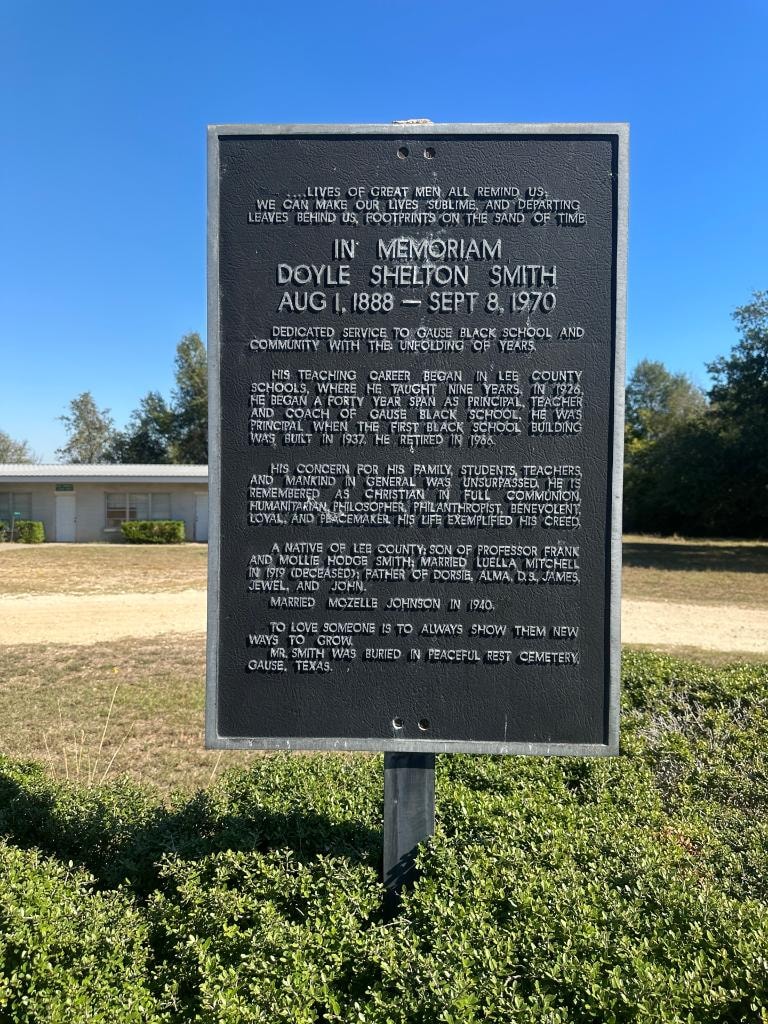
Doyle Shelton Smith
Son of Professor Frank Smith and Mollie Hodge Smith, Doyle Shelton Smith was born into the very legacy his family had helped build. His father carried the title of Professor — a title earned in the same community the Smiths had helped found. Doyle would spend his life honoring that inheritance.
His teaching career began in Lee County schools. In 1926, he began a forty-year span as principal, teacher, and coach of Gause Black School — the direct institutional descendant of the Gause freedom settlement. He was principal when the first Black school building was constructed in 1937. He retired in 1966.
The community remembered him as a Christian in full communion, humanitarian, philosopher, philanthropist, benevolent, loyal, and peacemaker. His concern for his family, students, teachers, and mankind was described as unsurpassed. He is buried at Peaceful Rest Cemetery, Gause, Texas.
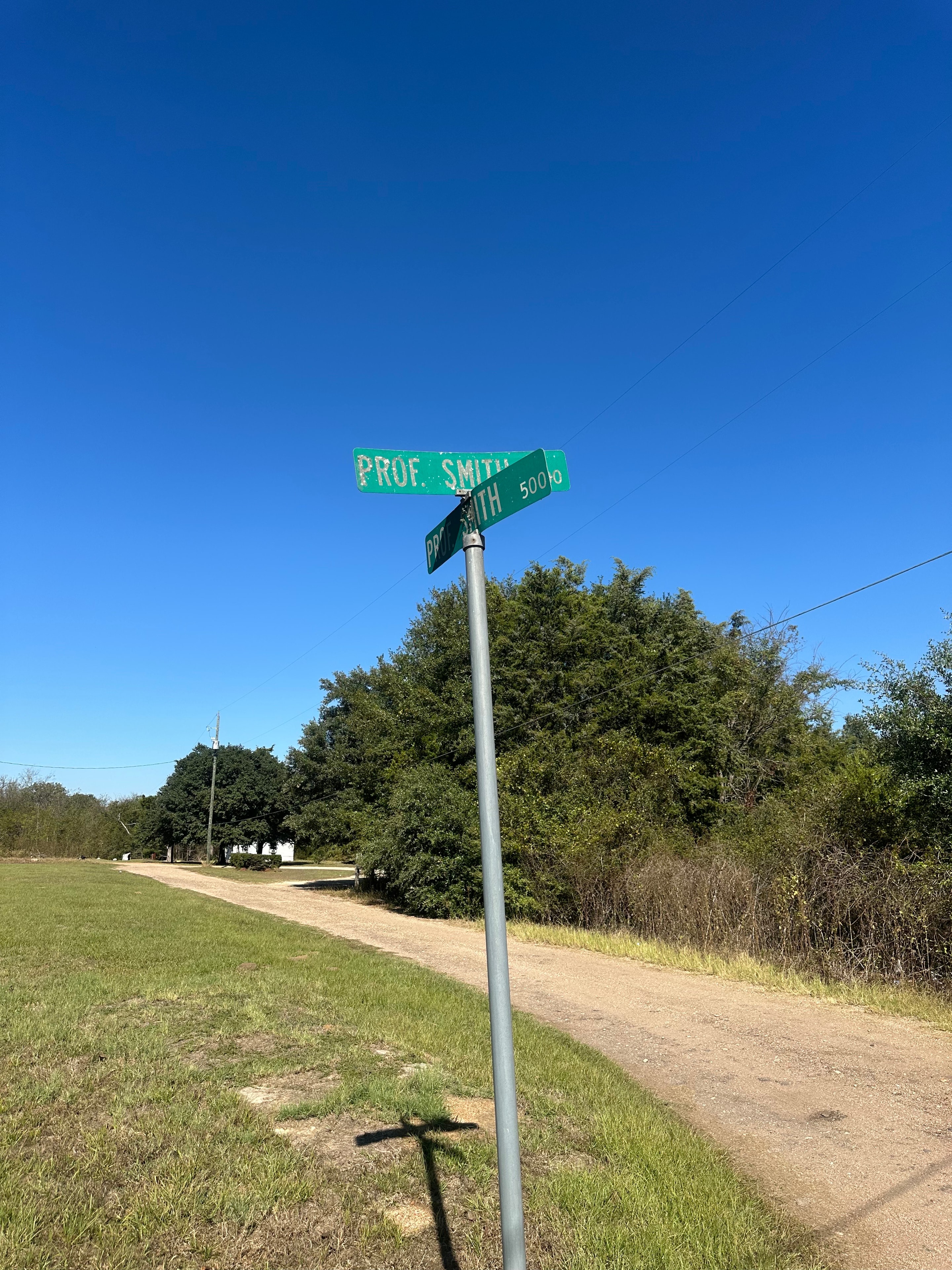
A road in Gause still bears his name — Prof. Smith — a living honorific that has outlasted the school building, the Reconstruction era, and a century of erasure. The community remembered. The record remembers. And now, so does this page.

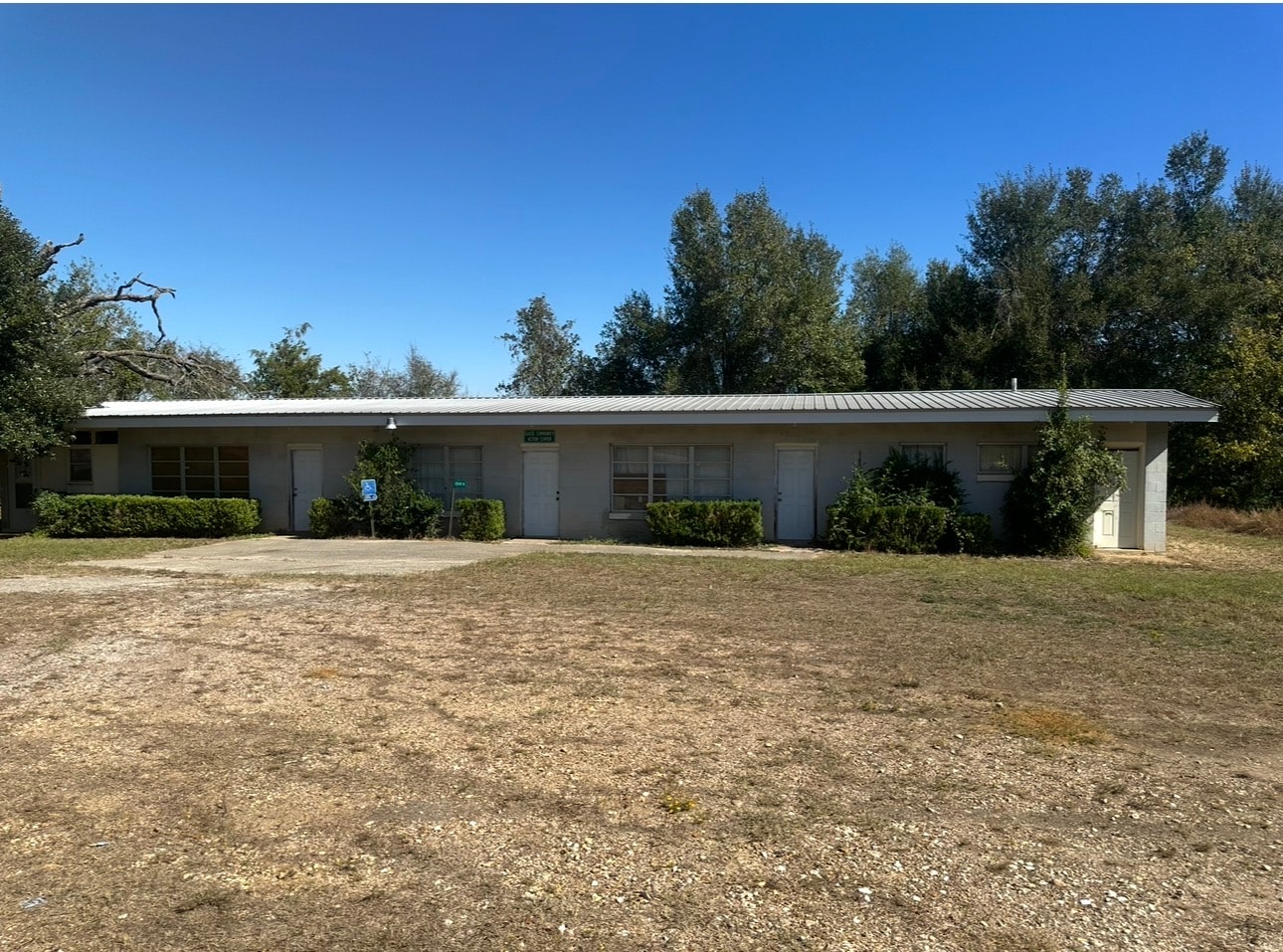
"The Burtons Smiths & Malone's championed education. Combined, 8 generations benefitted"
— Cyndal Malone Provenzano, Legacy Preservation Project
Two Cemeteries, One Kinship
“People with hate in their hearts will only see hate — but to me, side-by-side cemeteries are a testament to God’s love and kinship united. The law forced separation. The families never did.”
— Cyndal Malone Provenzano, Legacy Preservation Project
Gause White Cemetery
Anglo and white-classified residents. White fathers, white-passing kin, and those whose mixed lineage was hidden or unrecorded. Regulated by church and county custom. Burial here was a legal and social designation — not always a reflection of blood.
Peaceful Rest Cemetery
Black, Mulatto, and mixed-race residents. Black and mixed-race mothers, children classified by their mother’s race, and freedmen families who built the Gause freedom settlement. Doyle Shelton Smith is buried here. The Burton and Smith families are buried here.
Cemeteries in Gause were segregated even when families were mixed — because burial grounds were regulated by counties, churches, and community custom. Even when families loved each other, the public rules of segregation still applied. The result was the Gause White Cemetery and Peaceful Rest sitting side by side, close enough to see each other, close enough that everyone knew who was buried where. The law forced separation. The families did not. White fathers were buried in white cemeteries. Black and mixed-race mothers in Black cemeteries. Children split between both. It is heartbreaking — and historically accurate.
Post-1865 racism in Gause did not look like plantation racism. Gause was not a plantation town — it was a railroad town, a yeoman town, and a mixed-race kinship town. Some white families were violently racist. Some were quietly racist. Some were protective of their Black kin. Some were mixed themselves and hid it. The most dangerous racism often came from outsiders: county officials, vigilante groups, railroad enforcers, traveling mobs, Reconstruction-era militias, and early Klan groups. These outsiders did not know who was kin to whom — and they did not care. Local kin often resisted quietly: hiding relatives, sharing land, teaching literacy, helping with deeds, protecting children, providing shelter, marrying across racial lines, and forming freedom colonies. This is why families like the Smiths, Burtons, and Malones survived.
Anglo Burton and Smith kin hid people before and after emancipation using methods documented across the South. They called mixed-race or enslaved kin “farm hands” or “servants,” let them live in separate cabins called “tenant houses,” claimed them as “orphans” or “dependents,” moved them between kin households to avoid detection, and used church networks for protection. River bottom land like Two Mile Bottom was remote, flooded often, avoided by patrols, and controlled by yeoman families. The Burton and Smith kin of East Central Texas had both land and literacy — which made them unusually capable of protecting their people.
White kin were in danger too. White relatives who protected colored or mixed-race kin were punished with fines, land seizure, threats, arson, mob violence, social ostracism, church discipline, and being labeled “race traitors.” This is why some white Burton and Smith kin kept their protection quiet. They were not ashamed of their kin — they were afraid of outsiders.
Why two cemeteries side by side is evidence of mixed lineage
When cemeteries sit next to each other — separated only by a fence or a road — it means the families were connected, the land was originally shared, the community was mixed, and segregation was imposed later. The Gause White Cemetery and Peaceful Rest are not a symbol of division. They are a record of a kinship community that the law tried to separate and could not fully erase.
The Roads of Gause
These roads carried the Burtons, the Smiths, and their kin. They still run through the land where the Gause freedom settlement stood.
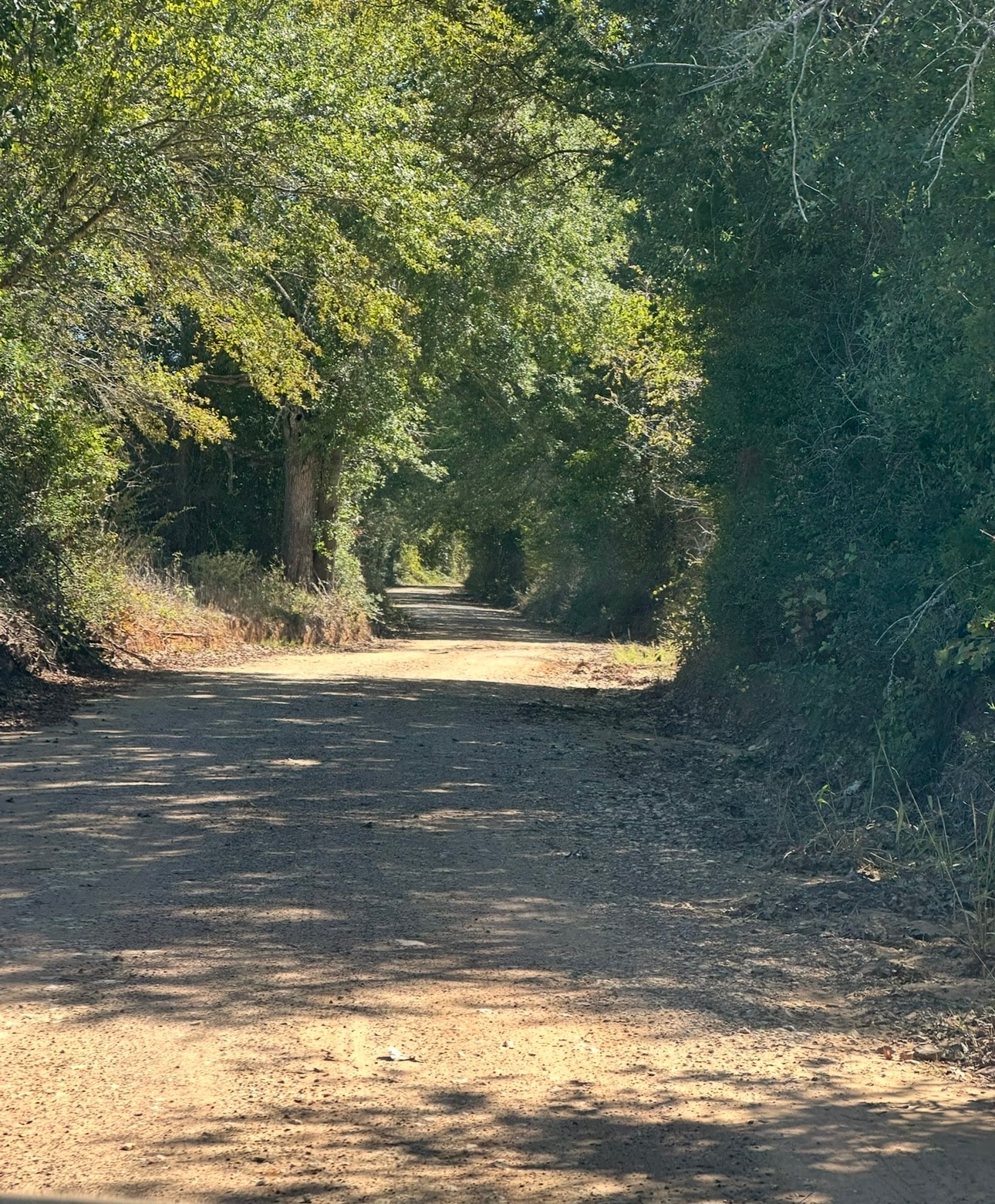
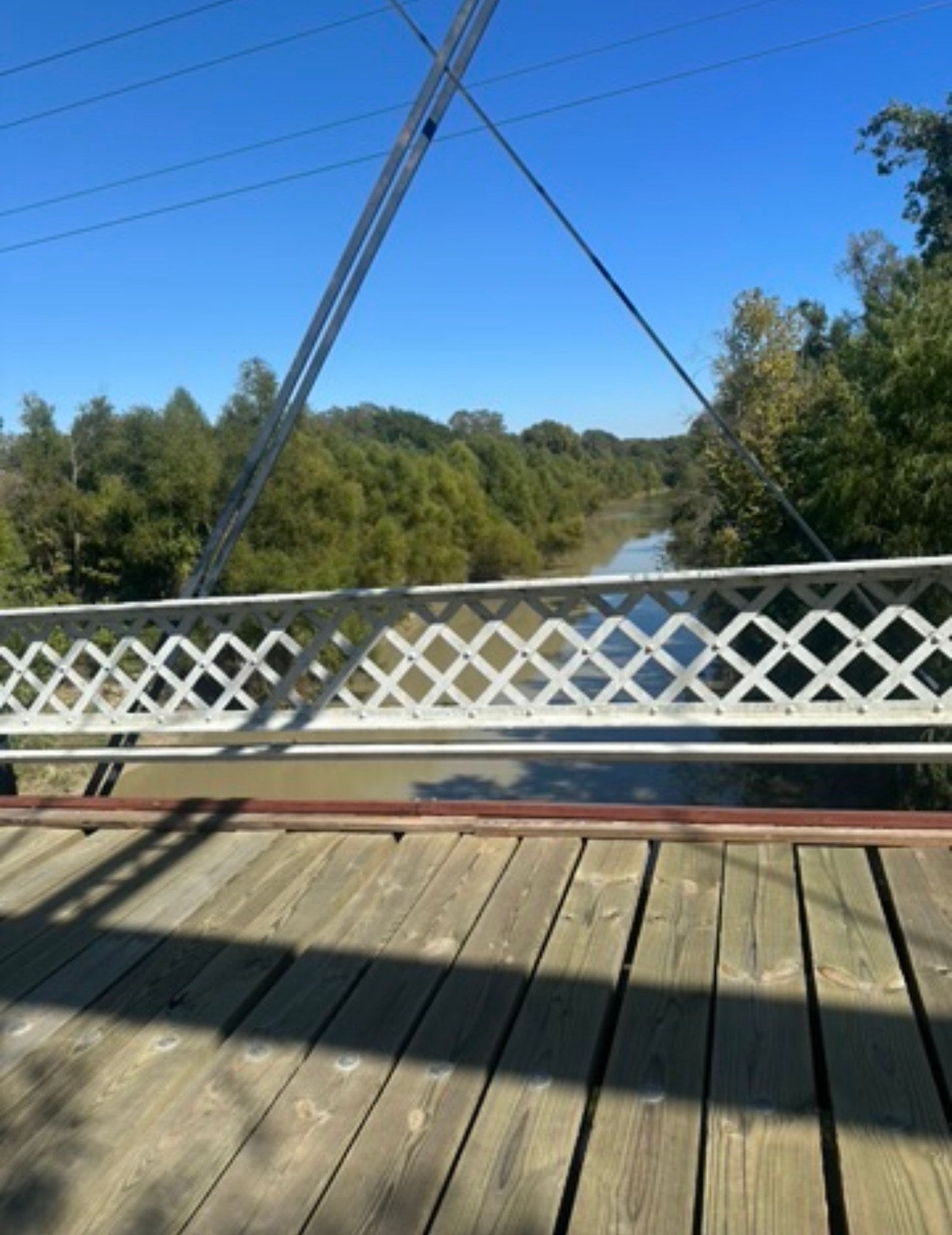
The Land Remembers
The Little River and the Sugarloaf Bridge mark the edges of the world the Burton and Smith families built. This is Tonkawa Land. The Malones never left and navigated the complex hidden caverns by the sun.
Tonkawa — We All Stay Together.

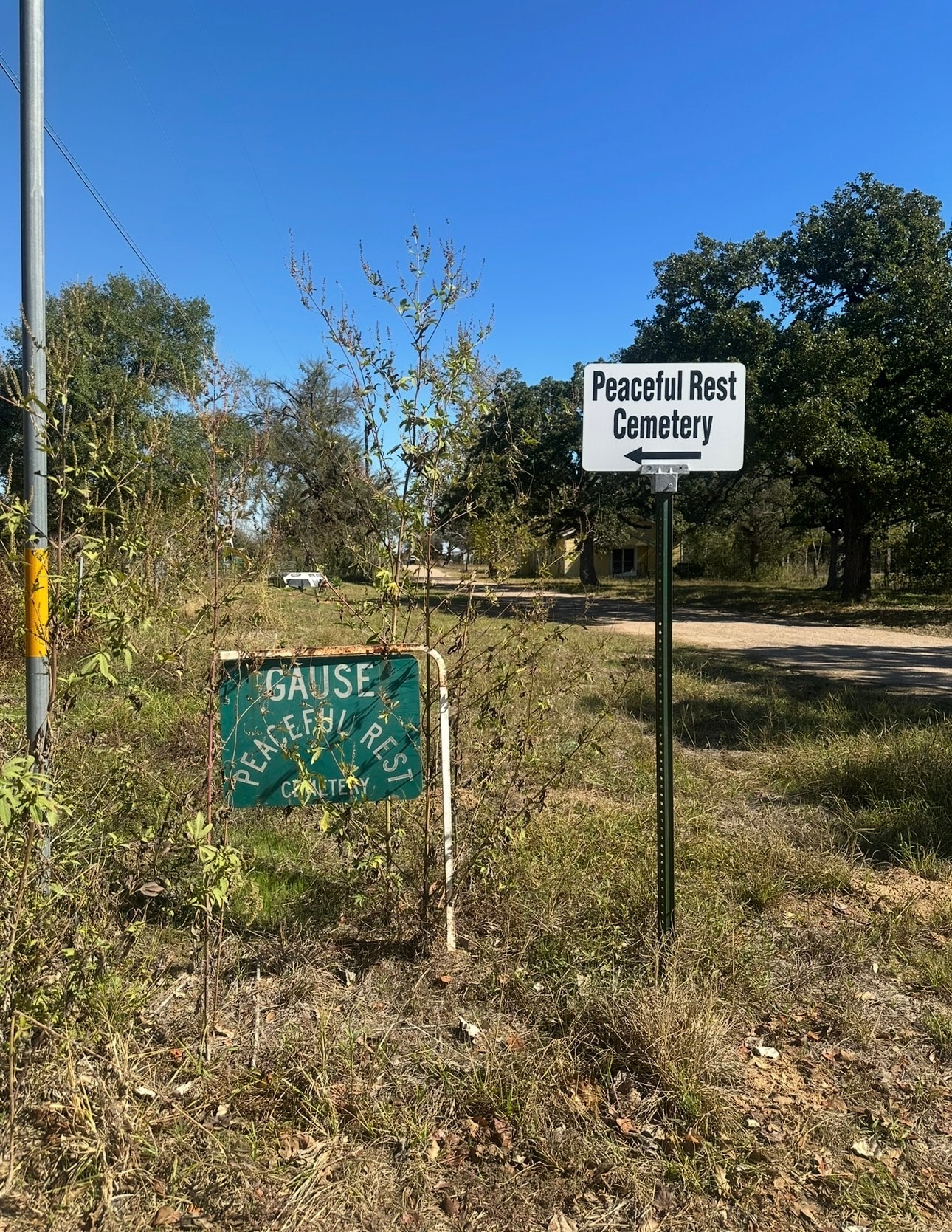
Peaceful Rest Cemetery
The Freedom Colony cemetery. Historically called the Negro Cemetery, the Colored Cemetery, the Family Cemetery. The names changed. The ground did not.
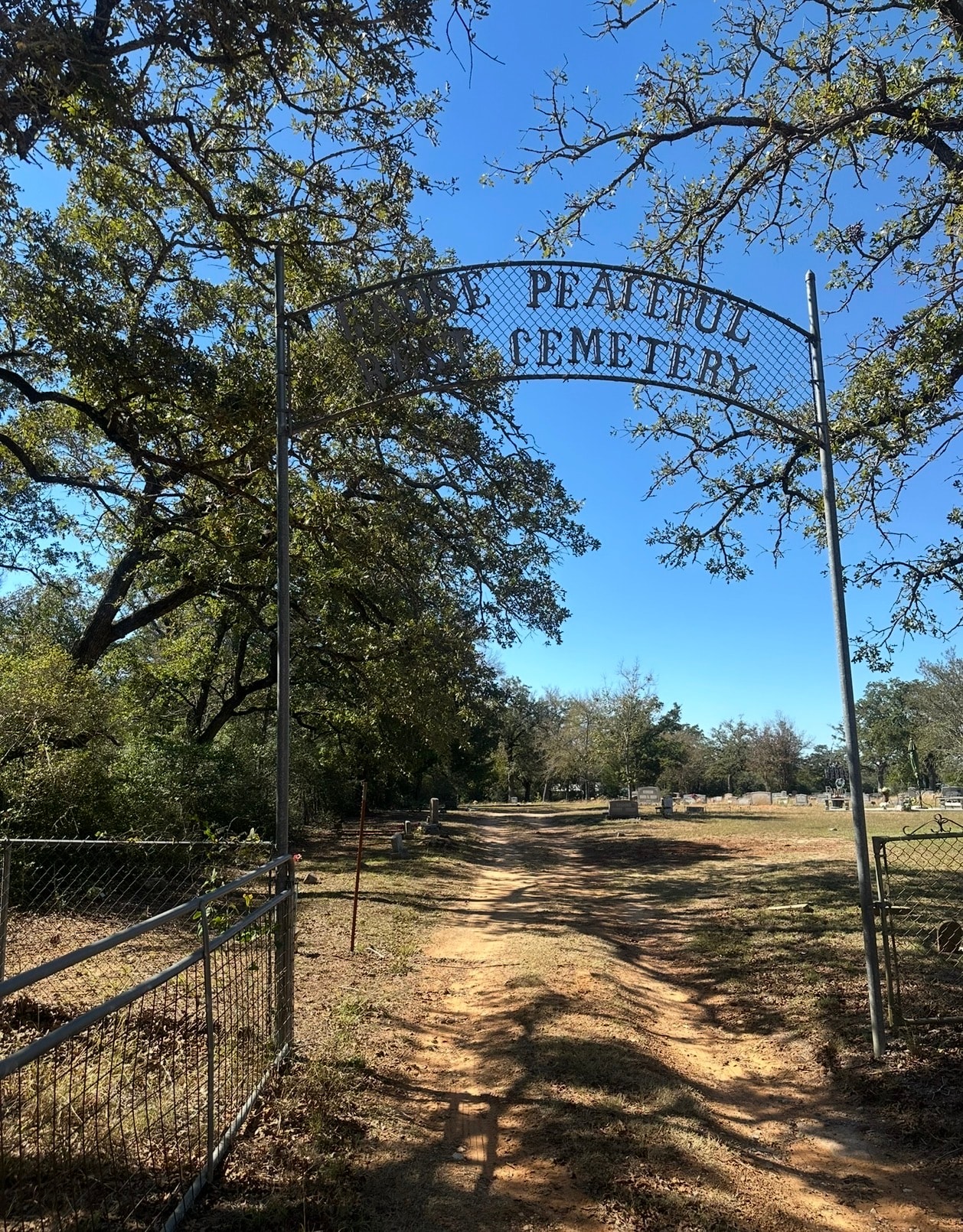
Peaceful Rest Cemetery is the Freedom Colony cemetery of Gause, Texas. It is still maintained. It is still standing. The gate is open.
Buried here: African, Free People of Color, and Mestizo triracial lines — The full spectrum of what this community was. The record tried to sort them into categories. The ground holds them together.
Doyle Shelton Smith — forty years of service to Gause Black School, principal, teacher, coach — is buried here.
Gause was home to 20 Freedom Colonies. Texas had more than 570 across the state — the highest concentration of any state in the nation. Walter Moses Burton is buried at Fort Bend County, not Gause. History labeled the sacred ground, the NEGRO Cemetery. The colony called it the family cemetery. Very well hidden & still maintained
Returning to Gause
In October 2026, The Tonkawa Indians who stayed who are tecnically classified as "Black" and Mestezo (The Malones) the family will return to Gause, Texas — to the land where the Burtons Malones and Smiths, built something that outlasted slavery, Reconstruction, and a century of erasure. This is a reunion. A homecoming. The descendants of the Gause freedom settlement coming back to stand on the ground their people never truly left.